
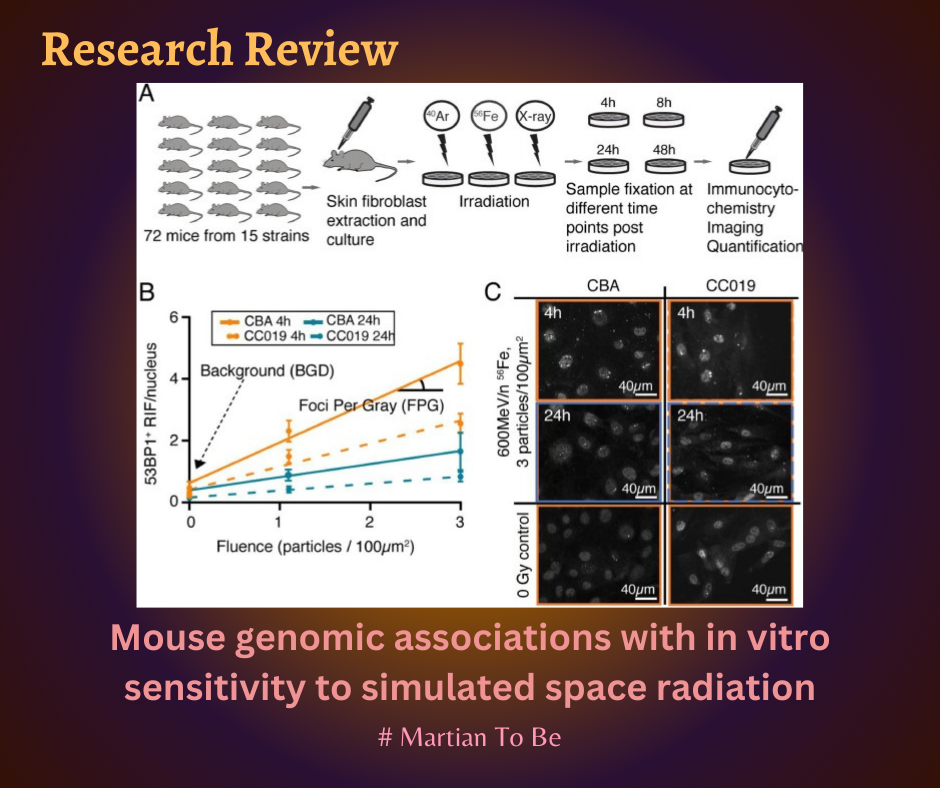
 Link to the paper: https://www.sciencedirect.com/…/pii/S2214552422000487
The study aimed to understand the genomic factors associated with sensitivity to ionizing radiation in mice, which is important for designing experiments in model organisms and evaluating radiation risks in astronauts. They identified genetic variations in 15 strains of mice associated with DNA damage responses and found associations with pathways related to cellular signaling, metabolism, tumorigenesis, and nervous system damage. The study also highlighted the importance of future human in vitro studies to refine the understanding of genes and pathways involved in the DNA damage response to radiation.
 Contributions of the paper
 Identified single nucleotide polymorphisms (SNPs) in 15 strains of mice associated with DNA damage responses to ionizing radiation, providing insights into the genomic factors influencing sensitivity to radiation exposure.
Found associations between the identified SNPs and pathways related to cellular signaling, metabolism, tumorigenesis, and nervous system damage, highlighting potential mechanisms involved in the DNA damage response to radiation.
Suggested the use of 53BP1 positive foci as a potential biomarker for DNA integrity in mouse models, indicating its potential utility in assessing radiation-induced DNA damage.
Emphasized the importance of future human in vitro studies to further refine the understanding of genes and pathways associated with the DNA damage response to ionizing radiation, aiding in the development of countermeasures for space travel.
 Practical Implications of the Paper
 Identification of genetic variations associated with DNA damage responses to ionizing radiation in mice can aid in the selection of suitable mouse models for studying radiation-related risks and developing countermeasures for space travel.
Understanding the pathways related to cellular signaling, metabolism, tumorigenesis, and nervous system damage can provide insights into the mechanisms underlying the DNA damage response to radiation and help identify potential therapeutic targets for limiting radiation-induced DNA damage.
The use of 53BP1 positive foci as a potential biomarker for DNA integrity in mouse models suggests its potential application in assessing radiation-induced DNA damage.
The importance of future human in vitro studies is highlighted to further refine the understanding of genes and pathways associated with the DNA damage response to ionizing radiation, which can aid in evaluating radiation risks in astronauts and developing targeted countermeasures.
 Methods used in this paper
Genome-wide association study (GWAS) was conducted using the collaborative cross (CC) mice, a panel of recombinant inbred strains, to identify mouse genes associated with sensitivity to space radiation.
Single nucleotide polymorphisms (SNPs) in 15 strains of mice were identified and analyzed for their association with in vitro DNA damage responses to ionizing radiation.
Immunofluorescent tumor protein p53 binding protein (53BP1) positive nuclear foci were quantified to measure DNA damage.
Statistical analysis was performed to determine the associations between SNPs and pathways related to cellular signaling, metabolism, tumorigenesis, and nervous system damage.
The R qtl2 package was used to determine the significance of SNP-phenotype associations and to incorporate kinship information between samples.
Pathway analysis was conducted using the qtl2 R package, Bioconductor package BiomaRt, and Reactome database to annotate SNPs, identify gene positions, and obtain pathway information.
 Data used in this paper
The study utilized the collaborative cross (CC) mice, a panel of recombinant inbred strains, to investigate the genomic associations with in vitro sensitivity to simulated space radiation.
Single nucleotide polymorphisms (SNPs) in 15 strains of mice, including 10 collaborative cross model strains and 5 founder strains, were identified and analyzed for their association with DNA damage responses.
In vitro DNA damage was quantified based on immunofluorescent tumor protein p53 binding protein (53BP1) positive nuclear foci.
Statistical analysis was performed to identify associations between SNPs and pathways related to cellular signaling, metabolism, tumorigenesis, and nervous system damage.
The R qtl2 package was used for determining the significance of SNP-phenotype associations and incorporating kinship information between samples.
Pathway analysis was conducted using the qtl2 R package, Bioconductor package BiomaRt, and Reactome database to annotate SNPs, identify gene positions, and obtain pathway information.
 Results of the paper
The study identified single nucleotide polymorphisms (SNPs) in 15 strains of mice associated with in vitro DNA damage responses to ionizing radiation. These SNPs were found to be related to pathways primarily involved in cellular signaling, metabolism, tumorigenesis, and nervous system damage .
Different genomic associations were observed in the early (4 and 8 hours) responses to different types of radiation, while later (24 hours) DNA damage responses showed a stronger overlap across all types of radiation .
Spontaneous DNA damage was also associated with a subset of pathways, suggesting the potential use of 53BP1 positive foci as a biomarker for DNA integrity in mouse models .
The study highlighted the importance of future human in vitro studies to further refine the association of genes and pathways with the DNA damage response to ionizing radiation and identify targets for space travel countermeasures .
The results also indicated major differences in radiosensitivity between mouse strains, suggesting the need to deliberately select strains based on experimental goals instead of relying solely on a few inbred strains .
We value your ideas and feel free to comment below.
Martian To Be Follow us 
