
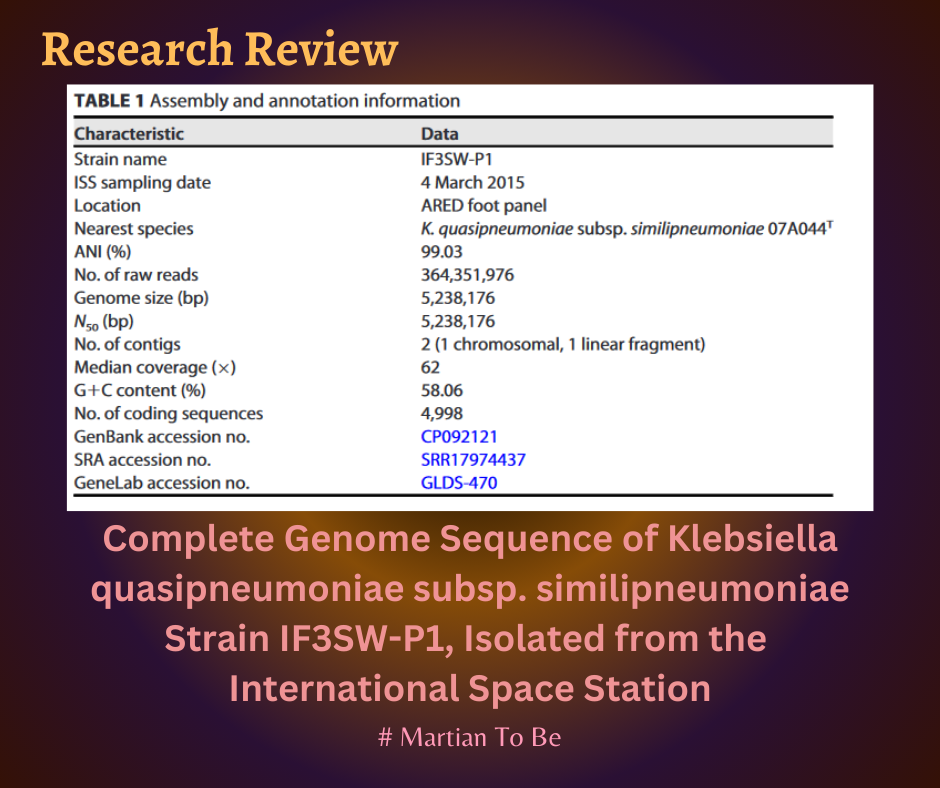
 Link to the paper: https://www.ncbi.nlm.nih.gov/pmc/articles/PMC9302127/
The paper presents the complete genome sequence of Klebsiella quasipneumoniae subsp. similipneumoniae strain IF3SW-P1, which was isolated from the International Space Station (ISS).
The genome lacks a megaplasmid typically found in hypervirulent and multidrug-resistant Klebsiella strains, but it does contain a chromosomally encoded OqxAB efflux pump associated with carbapenem resistance.
 Contributions of the paper
 The paper provides the complete genome sequence of Klebsiella quasipneumoniae subsp. similipneumoniae strain IF3SW-P1, which was isolated from the International Space Station (ISS) .
It identifies that the genome lacks a megaplasmid typically found in hypervirulent and multidrug-resistant Klebsiella strains, but it does contain a chromosomally encoded OqxAB efflux pump associated with carbapenem resistance .
The study highlights the presence of the OqxAB efflux pump, which is associated with resistance to benzalkonium chloride, a disinfectant used on the ISS .
The findings contribute to the understanding of the genomic characteristics and potential antibiotic resistance mechanisms of Klebsiella quasipneumoniae subsp. similipneumoniae strains, particularly those isolated from the ISS .
 Practical implications of the paper
 The identification of the chromosomally encoded OqxAB efflux pump associated with carbapenem resistance in the genome of Klebsiella quasipneumoniae subsp. similipneumoniae strain IF3SW-P1 has practical implications for understanding antibiotic resistance mechanisms in bacteria isolated from the International Space Station (ISS) .
The presence of the OqxAB efflux pump, which is associated with resistance to benzalkonium chloride, a disinfectant used on the ISS, raises concerns about the potential spread of antibiotic resistance in the confined environment of the space station .
The findings highlight the need for continued monitoring and surveillance of bacterial strains on the ISS to assess the risk of transmission and the development of multidrug-resistant infections in space .
Understanding the genomic characteristics of Klebsiella quasipneumoniae subsp. similipneumoniae strains can aid in the development of targeted strategies for infection control and the prevention of antibiotic resistance in both space and terrestrial settings .
 Methods used in this paper
The genome of Klebsiella quasipneumoniae subsp. similipneumoniae strain IF3SW-P1 was sequenced using Oxford Nanopore Technologies .
The strain was isolated from the surface of the foot panel of the Advanced Resistive Exercise Device (ARED) on the International Space Station (ISS) using a standard spread plate method on Reasoner’s 2A (R2A) agar .
Genomic DNA was extracted from the subcultured strain using the DOE Joint Genome Institute bacterial genomic DNA isolation protocol .
The assembly of the genome was annotated using RASTtk v1.3.0 as part of the Pathosystems Resource Integration Center (PATRIC) v3.6.12 .
The presence of virulence genes and the multidrug resistance efflux pump OqxAB in the genome was determined through annotation and analysis .
Note: The methods section of the paper may provide more detailed information on the specific protocols and parameters used for sequencing, DNA extraction, and annotation.
 Data used in this paper
The data used in this paper includes the complete genome sequence of Klebsiella quasipneumoniae subsp. similipneumoniae strain IF3SW-P1, which was isolated from the International Space Station (ISS) .
The strain was isolated from the surface of the foot panel of the Advanced Resistive Exercise Device (ARED) on the ISS using a standard spread plate method on Reasoner’s 2A (R2A) agar .
Genomic DNA was extracted from the subcultured strain and sequenced using Oxford Nanopore Technologies .
The genome assembly was annotated using RASTtk v1.3.0 as part of the Pathosystems Resource Integration Center (PATRIC) v3.6.12 .
The presence of virulence genes and the multidrug resistance efflux pump OqxAB in the genome was determined through annotation and analysis .
Note: The paper does not explicitly mention any other external datasets or data sources used in the analysis.
 Results of the paper
The complete genome sequence of Klebsiella quasipneumoniae subsp. similipneumoniae strain IF3SW-P1, isolated from the International Space Station (ISS), was obtained using Oxford Nanopore Technologies .
The genome lacks a megaplasmid typically found in hypervirulent and multidrug-resistant Klebsiella strains but does contain a chromosomally encoded OqxAB efflux pump associated with carbapenem resistance .
The average nucleotide identity (ANI) analysis confirmed that strain IF3SW-P1 is related to but distinct from previously published draft genomes of K. quasipneumoniae strains isolated from the ISS .
The genome assembly was annotated, and predicted virulence genes on the chromosome, such as iutA encoding a ferric aerobactin receptor, were identified .
The IF3SW-P1 genome also contains genes for the multidrug resistance efflux pump OqxAB, associated with carbapenem resistance in K. pneumoniae .
The presence of OqxAB is reported to be associated with resistance to benzalkonium chloride, a disinfectant used on the ISS .
Note: The paper does not provide specific experimental results or findings beyond the genome sequence and the presence of specific genes associated with resistance.
We value your ideas and feel free to comment below.
Martian To Be Follow us 
