
 Link to the paper: https://www.sciencedirect.com/…/pii/S2589004222009592…
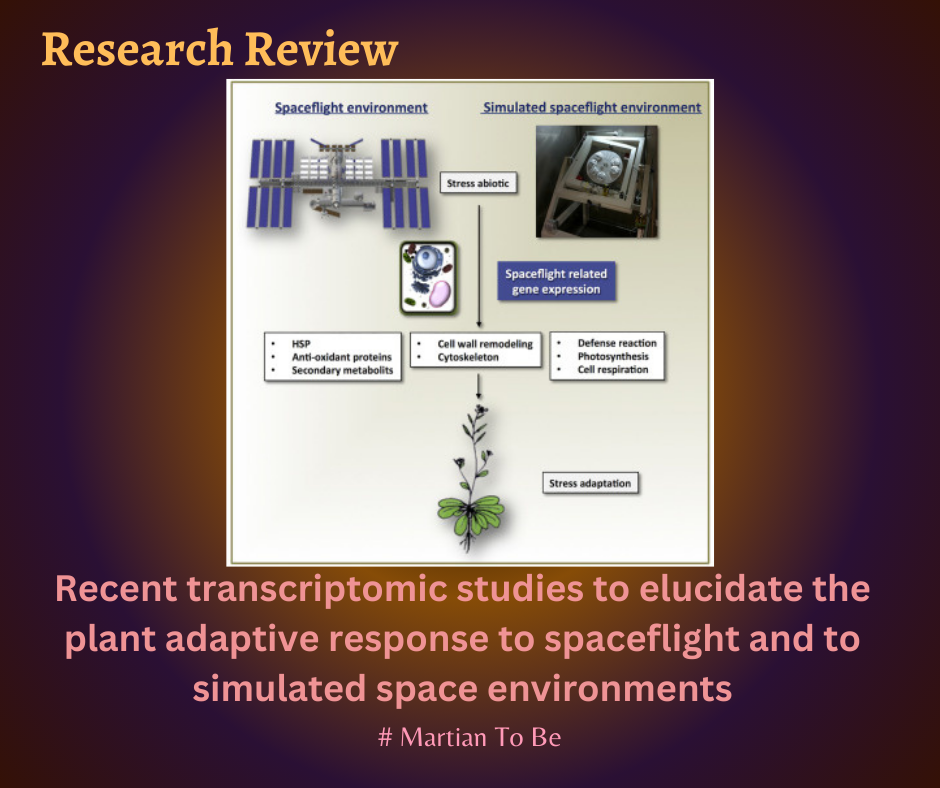
Transcriptomic analyses have been used to identify the adaptation response pathways of plants to the space environment, including altered gravity and cosmic radiation.
These studies have revealed that cell wall remodeling, oxidative stress, defense response, and photosynthesis are common altered processes in plants grown under spaceflight conditions.
 Contributions of the paper
 The paper reviews transcriptomic studies conducted on plants grown in spaceflights and ground-based microgravity simulators, highlighting the common altered processes such as cell wall remodeling, oxidative stress, defense response, and photosynthesis in plants under spaceflight conditions.
The paper emphasizes the importance of real microgravity research conducted onboard the International Space Station (ISS) in providing valuable information about changes in gene expression at the global genome level. It acknowledges the high cost and limited access to ISS research but highlights the knowledge acquired from relevant experiments performed in the last decade.
The paper also mentions the contributions of European scientists in understanding the role of red light in plant adaptation response and the mechanisms of cellular response and adaptation affecting cell cycle regulation.
It discusses the challenges in designing and developing experimental hardware for low gravity conditions, emphasizing the need to understand the differential results observed in different facilities and suboptimal environmental conditions.
 Practical implications of the paper
 Understanding the adaptation mechanisms of plants to the space environment is crucial for supporting human space exploration. Transcriptomic analyses provide valuable insights into the changes in gene expression at the global genome level caused by altered gravity and cosmic radiation.
The identification of common altered processes in plants grown under spaceflight conditions, such as cell wall remodeling, oxidative stress, defense response, and photosynthesis, can inform the development of strategies to optimize plant growth and support long-term space missions.
The European contribution to the acquisition of knowledge in this field, particularly in understanding the role of red light in plant adaptation response and the mechanisms of cellular response and adaptation, highlights the importance of international collaboration in advancing research on plant biology in space.
The findings from these transcriptomic studies can guide the design of future experiments, the selection of suitable crop plant models, and the optimization of environmental conditions for plant growth in space.
 Methods used in this paper
Transcriptomic analyses were conducted on plants grown in spaceflights and ground-based microgravity simulators to identify changes in gene expression at the global genome level.
RNAseq and microarray techniques were utilized as space transcriptomics tools to study the adaptation mechanisms of plants to spaceflight conditions.
The NASA GeneLab data repository was used as a reference to locate works studying the plants’ adaptive response to space environments through transcriptomic analysis. Manual searches were also conducted in other databases such as Web of Science, Google Scholar, and PMC-NIH.
Experiments were performed in different microgravity simulators and facilities, including the European Modular Cultivation System (EMCS) and the BRIC hardware, to study gene expression changes in well-controlled environmental conditions.
The study also involved the use of A. thaliana lines, such as wild type (WT) and transgenic plants expressing specific genes, to investigate the response of plants to spaceflight conditions.
 Data used in this paper
Transcriptomic data from plants grown in spaceflights and ground-based microgravity simulators were analyzed to understand the adaptive response of plants to the space environment.
The NASA GeneLab data repository was used as a reference to locate transcriptomic studies on plants’ adaptive response to space environments.
The data included in the GeneLab Data Set (GLDS) was used to identify gene expression changes in well-controlled environmental conditions, including different light profiles and partial gravity levels.
The paper also mentioned the incorporation of space transcriptomics tools such as RNAseq and microarrays, which have provided more than 25 datasets deposited in the GeneLab database.
In addition to the GeneLab data repository, manual searches were conducted in other databases such as Web of Science, Google Scholar, and PMC-NIH to find relevant studies on transcriptomic changes in plants exposed to space environments.
Note: The paper does not provide specific details about the individual datasets or specific studies included in the analysis.
 Results of the paper
Transcriptomic studies on plants grown in spaceflights and ground-based microgravity simulators have revealed common altered processes in plants under spaceflight conditions, including cell wall remodeling, oxidative stress, defense response, and photosynthesis .
European scientists have made significant contributions to understanding the adaptive response of plants to space environments, such as the role of red light in plant adaptation and the mechanisms of cellular response and adaptation affecting cell cycle regulation .
Experiments using Arabidopsis thaliana seedlings in different microgravity simulators have provided insights into the adaptive response of plants to the spaceflight environment, including changes in gene expression related to cell polarity, cell defense or stress, and cell wall development .
The comparison of spaceflight samples with ground samples identified differentially regulated genes involved in key developmental pathways, suggesting the influence of gravity on these processes .
The use of transcriptomic analysis in the CEL BRIC-17 experiment revealed the differential expression of genes related to gravisignaling and defense response in Arabidopsis cell cultures .
Note: The paper does not provide specific quantitative results or statistical analyses.
We value your ideas and feel free to comment below.
Martian To Be Follow us 
