
Introduction
Spaceflight introduces extreme stressors like microgravity and radiation, which impact biological systems differently based on age. In female mammals, these effects may increase the risk of pathologies such as breast cancer. This study leverages a machine learning ensemble to explore gene expression in young and old female mice exposed to spaceflight, uncovering age-dependent molecular responses with implications for cardiovascular and cancer biology.
Contributions of the Paper
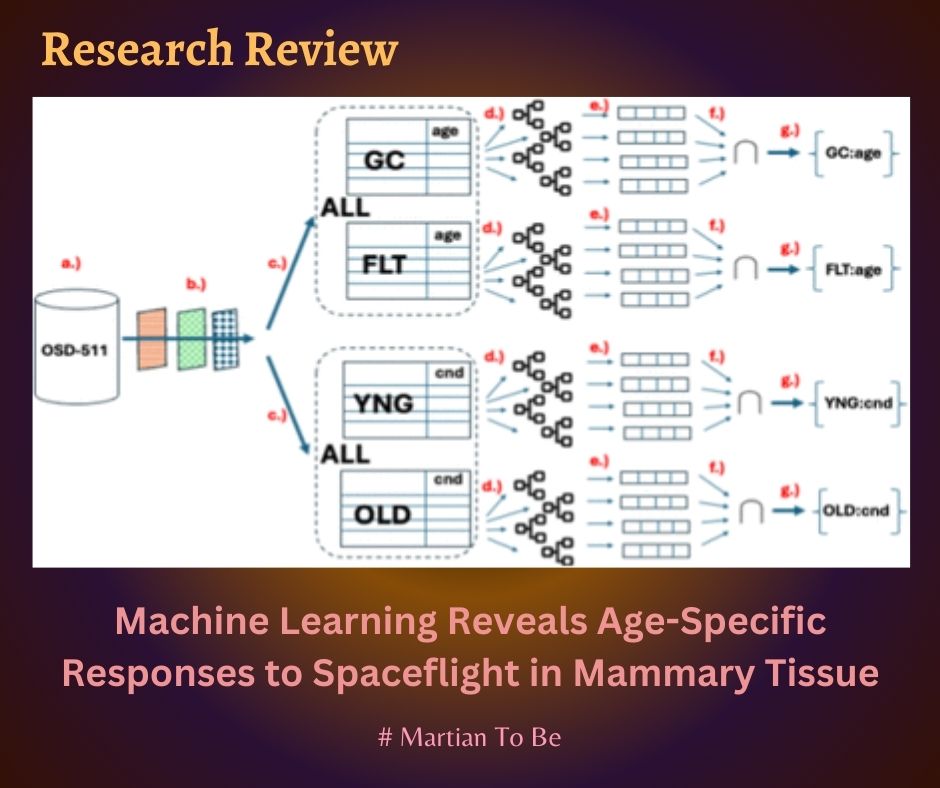
Developed an ensemble machine learning pipeline to predict age and condition (spaceflight vs. ground control) from gene expression.
Revealed distinct gene expression profiles in young vs. old mice following spaceflight.
Identified key molecular pathways linked to stress responses, tissue remodeling, and disease susceptibility.
Practical Implications of the Paper
Offers insights into personalized astronaut health risk assessments, especially for women.
Enables targeted studies on age-specific countermeasures to mitigate spaceflight-induced health risks.
Serves as a blueprint for machine learning applications in space biology.
Methods Used in the Paper
Used supervised ML models: Random Forest, Logistic Regression, Single-Layer Perceptron, and SVM.
Employed cross-validation and permutation feature importance to extract relevant gene features.
Applied ensemble voting and set operations to isolate age- and condition-specific gene predictors.
Data Used in the Paper
RNA-seq data from NASA’s OSDR (OSD-511) involving young (10–12 weeks) and old (32 weeks) female mice.
Gene expression measured across flight and ground controls using RSEM and STAR pipelines, followed by DESeq2 normalization.
Results of the Paper
Young mice showed gene enrichment in extracellular matrix and cytoskeletal pathways.
Old mice had predictive genes related to lipid metabolism, calcium signaling, and stress responses.
Spaceflight effects in old mice linked to cardiovascular and endocrine stress, while young mice showed structural adaptation signals.
Identified genes such as Plin2, Scd2, Cacna1s, Flna, Col4a1, linked to aging, cardiovascular health, and cancer biology.
Conclusions from the Paper
Age plays a critical role in modulating the mammary gland’s response to spaceflight.
Identified gene signatures may predict susceptibility to spaceflight-induced disorders such as breast cancer and metabolic diseases.
Machine learning models can effectively derive insights from high-dimensional biological data even with limited samples.
Limitations of the Paper
Modest sample size limits model generalizability.
Performance of linear models was suboptimal in high-dimensional, non-linear gene expression spaces.
Lack of functional validation for predicted gene roles.
Future Works Suggested in the Paper
Extend the ML ensemble framework to larger, multi-tissue, and multi-timepoint datasets.
Validate findings in clinical and in vivo studies of radiation and cancer risk.
Explore real-time biomarker monitoring for spaceflight missions
