
Introduction
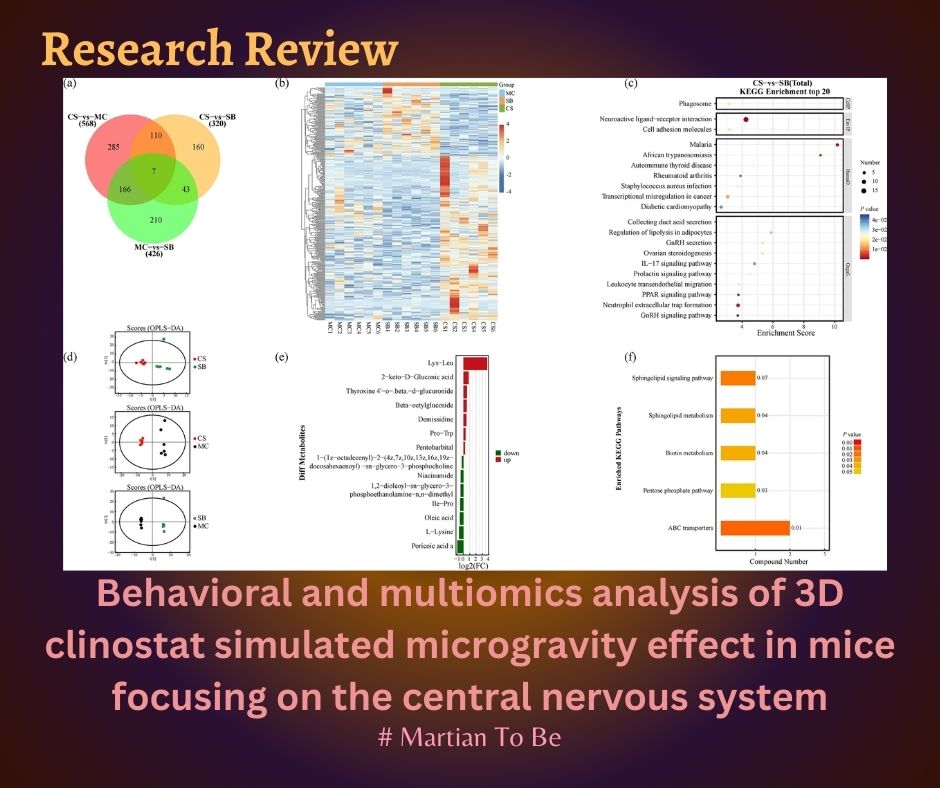
This study by Zhou et al. evaluates the physiological and molecular effects of simulated microgravity on mice using a three-dimensional (3D) clinostat. As traditional hindlimb unloading models fall short in replicating whole-body microgravity, this research pioneers a novel approach, comparing behavioral, transcriptomic, metabolomic, and microbiomic responses in mice exposed to clinostat conditions. By demonstrating changes in fear behavior, gait, brain gene expression, and gut microbiota, the paper underlines the clinostat’s value as a ground-based analog for spaceflight. The comprehensive design mimics central nervous system alterations observed in astronauts, revealing critical insights for space biology.
Contributions of the Paper
Introduced a full-body 3D clinostat model to simulate microgravity more holistically than localized models.
Highlighted its effectiveness by aligning transcriptomic changes with those observed in actual spaceflight mice.
Showed how this model offers a platform to study CNS and systemic effects of microgravity in a lab setting.
Practical Implications of the Paper
Enables cost-effective, ethical ground-based studies of long-term spaceflight effects.
Offers a viable model for testing countermeasures for astronaut health issues (e.g., neurobehavioral shifts, immune dysregulation).
Suggests potential use in pre-spaceflight training and screening for susceptibility to space-induced stress.
Methods Used in the Paper
Used behavioral assays like open field, Y-maze, fear conditioning, and Morris water maze.
Analyzed bone changes via femur micro-CT scanning.
Conducted whole-brain transcriptomic profiling via RNA-seq.
Performed serum metabolomics using LC-MS.
Carried out 16S rRNA sequencing for gut microbiota assessment.
Data Used in the Paper
Involved 18 male mice split across control, survival box, and 3D clinostat groups.
Collected behavioral metrics, gene expression data, metabolite profiles, and microbiome composition.
Compared these with public datasets from hindlimb unloading and spaceflight models.
Results of the Paper
CS mice showed reduced exploratory activity and significant changes in gait and balance.
No major impairments in learning/memory, but enhanced fear memory and delayed extinction.
Brain transcriptomics revealed immune and endocrine signaling alterations.
Serum analysis found upregulation/downregulation in key metabolic pathways.
Gut microbiota showed reduced diversity and specific taxonomic shifts (e.g., lower Bacteroides).
Conclusions from the Paper
The 3D clinostat closely mimics neurobiological changes seen in space, more than HU models.
It is particularly effective for CNS-related research, offering a robust analog for studying microgravity on Earth.
Emotional and vestibular systems are more affected than cognitive functions under simulated conditions.
Limitations of the Paper
Limited to male mice; potential sex-specific differences remain unexplored.
Small sample size may underrepresent subtle behavioral or molecular shifts.
Social isolation and spatial confinement may confound some results.
Differences in exposure times and protocols across compared models limit transcriptomic alignment.
Future Works Suggested in the Paper
Explore sex-based differences in microgravity responses using female mice.
Focused studies on brain regions like the amygdala, hippocampus, and prefrontal cortex.
Develop targeted therapies (e.g., probiotics, hormone modulators) to mitigate microgravity effects.
Extend research duration to examine long-term cognitive consequences.
