
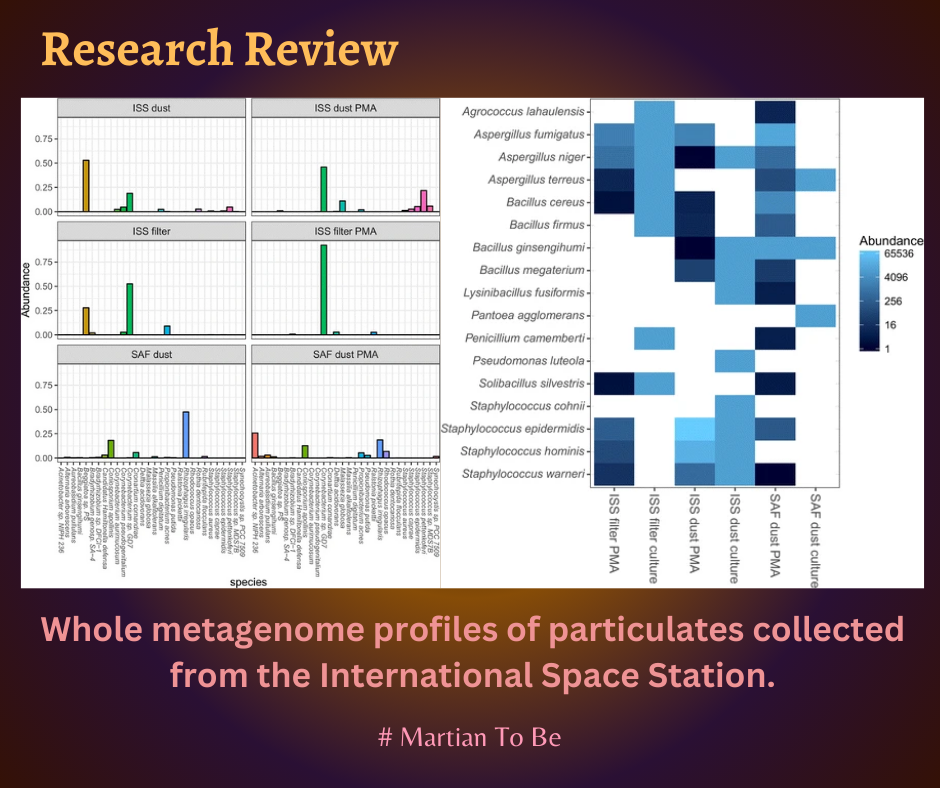
 Link to the paper: https://microbiomejournal.biomedcentral.com/…/s40168…
The paper examines the whole metagenome of microbes present in the International Space Station (ISS) and compares it with samples collected in a terrestrial cleanroom environment. The study aims to understand the microbial content and ecology of the ISS and its potential impact on human health.
This paper contributes to the understanding of the microbial content and ecology of the International Space Station (ISS) and its potential impact on human health. It examines the whole metagenome of microbes present in the ISS and compares it with samples collected in a terrestrial cleanroom environment. The study provides insights into the functional genomics of ISS microbes, including their antimicrobial resistance and virulence genes. The observations and studies such as these will be important to evaluating the conditions required for long-term health of human occupants in such environments. The practical implications of this paper are as follows:
 The study provides insights into the microbial content and ecology of the International Space Station (ISS) and its potential impact on human health.The findings of this study may inform future approaches toward reducing the relative presence of pathogenic microbes and further understanding which microbiome compositions are amenable to healthy conditions for future space travelers.The study highlights the importance of monitoring the microbial content of closed environments such as the ISS to ensure the long-term health of human occupants.The study also demonstrates the usefulness of whole metagenome analysis in understanding the functional genomics of microorganisms in unique environments such as the ISS.The data generated from this study may be used to develop countermeasures during future long-term space missions to mitigate the potential pathogenic effects of microorganisms in space habitats.
Overall, this study has practical implications for the health and safety of astronauts during long-term space missions and for the development of strategies to mitigate the potential pathogenic effects of microorganisms in space habitats. The methods used in this paper include:
 Analysis of air filter and dust samples from the International Space Station (ISS) and comparison with samples collected in a terrestrial cleanroom environment.Whole metagenome analysis of ISS microbes at both species- and gene-level resolution using LMAT for sequence analysis.Taxonomic network analyses using DIAMOND and MEGAN5-based network tools.Development of a node table using QIIME and visualization of the node table using Cytoscape.Metagenome mining to characterize dominant, virulent, and novel microorganisms.Extraction of whole genome sequences of select cultivable strains isolated from these samples and comparison with the metagenome.Examination of microbial genes relevant to human health such as antimicrobial resistance and virulence genes.Use of PMA-treated samples to detect genes derived from viable microorganisms.Amplification of sequences using MDA prior to library preparation and potential for bias in relative abundance levels due to amplification procedures.Comparison of microbial content associated with astronauts with the human microbiome adjusted to habitation within the ISS.
Overall, the methods used in this paper provide a comprehensive approach to understanding the microbial content and ecology of the ISS and its potential impact on human health.
The data used in this paper includes air filter and dust samples from the International Space Station (ISS) and comparison with samples collected in a terrestrial cleanroom environment. The whole metagenome of ISS microbes at both species- and gene-level resolution was analyzed using LMAT for sequence analysis. Taxonomic network analyses were performed using DIAMOND and MEGAN5-based network tools. Metagenome mining was carried out to characterize dominant, virulent, and novel microorganisms. The whole genome sequences of select cultivable strains isolated from these samples were extracted from the metagenome and compared. Additionally, microbial genes relevant to human health such as antimicrobial resistance and virulence genes were examined.
The results of the paper indicate that the microbial composition of the International Space Station (ISS) is distinct from that of a terrestrial cleanroom environment. The species-level composition in the ISS was found to be largely dominated by Corynebacterium ihumii GD7, with overall microbial diversity being lower in the ISS relative to the cleanroom samples. When examining detection of microbial genes relevant to human health such as antimicrobial resistance and virulence genes, it was found that a larger number of relevant gene categories were observed in the ISS relative to the cleanroom. Strain-level cross-sample comparisons were made for Corynebacterium, Bacillus, and Aspergillus showing possible distinctions in the dominant strain between samples. The overall population of viable microorganisms and the functional diversity inherent to this unique closed environment are of critical interest with respect to future space habitation.
We value your ideas and feel free to comment below.
