
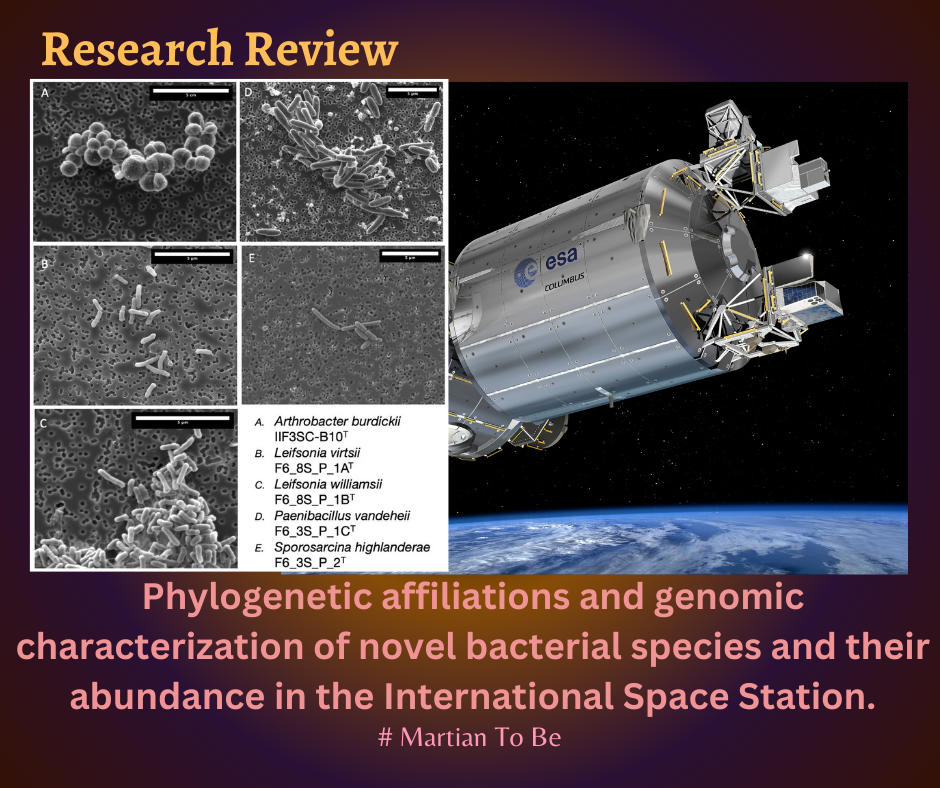
 Link to the paper: http://dx.doi.org/10.21203/rs.3.rs-3126314/v1
The paper discusses the isolation and characterization of six unique strains of Gram-positive bacteria from the environmental surfaces of the International Space Station (ISS), which were found to be novel species based on phylogenetic analysis and whole genome sequencing. The study aims to understand the microbiome of space habitats and how microbes survive, proliferate, and spread in space conditions.
The contributions of this paper are as follows:
 The paper provides insights into the microbiome of space habitats and how microbes survive, proliferate, and spread in space conditions.
The study isolated and characterized six unique strains of Gram-positive bacteria from the environmental surfaces of the International Space Station (ISS), which were found to be novel species based on phylogenetic analysis and whole genome sequencing.
The paper proposes the names of these novel species based on their taxonomic classification.
The study helps in identifying potential pathogens and understanding their potential impact on the spacecraft and its equipment.
The paper emphasizes the importance of having an up-to-date, comprehensive database of microbial genomes, their species identity, and their phenotypic characteristics for easily detecting or identifying a potential microbial threat.
The practical implications of this paper are as follows:
 The study provides valuable information for designing effective infection control measures and developing strategies to combat the spread of antibiotic resistance in space habitats.
The identification of potential pathogens and their characteristics can help in developing targeted approaches for cleaning and disinfecting the spacecraft and its equipment.
The study highlights the need for regular monitoring of the microbiome of space habitats to ensure the safety of astronauts and equipment.
The identification of novel bacterial species and their genomic characterization can contribute to the development of new antibiotics and other therapeutic agents.
The study emphasizes the importance of maintaining a comprehensive database of microbial genomes, their species identity, and their phenotypic characteristics for easily detecting or identifying a potential microbial threat.
Overall, the practical implications of this paper can help in ensuring the safety and well-being of astronauts and equipment in space habitats.
The introduction of this paper discusses the importance of understanding the microbiome of space habitats and how microbes survive, proliferate, and spread in space conditions. The paper focuses on the International Space Station (ISS), which is the only space habitat currently in orbit with a long-term history of human habitation. The surfaces of the ISS are routinely cleaned to maintain a low biomass level, but some resilient microbes have adapted to microgravity conditions and persist. The paper describes the ongoing Microbial Tracking investigation of the ISS and the isolation of six unique strains of Gram-positive bacteria from the environmental surfaces of the ISS, which were found to be novel species based on phylogenetic analysis and whole genome sequencing. The paper emphasizes the importance of characterizing the genomes and adaptation mechanisms of rare or novel species that manage to recolonize ISS surfaces, as they are more likely to have narrow niche breadth and are persisting due to adaptive mechanisms to the stresses of radiation, desiccation, and microgravity conditions. The paper concludes by stating that the process of characterizing the previously unsequenced cultivable microbiome of space habitats continues to reduce the amount of microbial ‘dark matter’ found in metagenomic sequencing results.
The paper describes the methods used to isolate and characterize the six novel bacterial species from the environmental surfaces of the International Space Station (ISS). The methods used in this paper are:
 Isolation of bacterial strains from ISS surfaces using swabbing and culturing techniques.
Identification of bacterial strains using 16S rRNA gene sequencing and phylogenetic analysis.
Whole genome sequencing (WGS) of bacterial strains to further explore their phylogenetic affiliation and identify novel species.
Traditional biochemical tests, fatty acid profiling, polar lipid, and cell wall composition analyses to generate phenotypic characterization of the bacterial strains.
Shotgun metagenomic sequencing of ISS samples to determine the abundance of the novel species.
Annotation of the bacterial genomes to identify genes associated with virulence, disease, and defense.
AntiSMASH analysis to identify gene clusters associated with secondary metabolite biosynthesis.
Oxford Nanopore sequencing for strains IIF3SC-B10 T and F6_8S_P_1B T to obtain long-read sequencing data.
Overall, the paper uses a combination of microbiological, molecular, and bioinformatic techniques to isolate, identify, and characterize novel bacterial species from the ISS environment.
The data used in this paper includes:
 Isolation and culturing of bacterial strains from environmental surfaces of the International Space Station (ISS).
16S rRNA gene sequencing data to identify bacterial strains and determine their phylogenetic affiliation.
Whole genome sequencing (WGS) data to further explore the phylogenetic affiliation of the bacterial strains and identify novel species.
Traditional biochemical tests, fatty acid profiling, polar lipid, and cell wall composition analyses to generate phenotypic characterization of the bacterial strains.
Shotgun metagenomic sequencing data of ISS samples to determine the abundance of the novel species.
Annotation of the bacterial genomes to identify genes associated with virulence, disease, and defense.
AntiSMASH analysis to identify gene clusters associated with secondary metabolite biosynthesis.
Oxford Nanopore sequencing data for strains IIF3SC-B10 T and F6_8S_P_1B T to obtain long-read sequencing data.
Therefore, the paper uses a variety of microbiological, molecular, and bioinformatic data to characterize the novel bacterial species isolated from the ISS environment.
The results of the paper show that six novel bacterial species were isolated from the environmental surfaces of the International Space Station (ISS). These novel species belong to five different bacterial genera and were identified using a combination of microbiological, molecular, and bioinformatic techniques. The paper provides detailed information on the phylogenetic affiliation, genomic characterization, and phenotypic characterization of these novel species. The results also show that these novel species are rare in the ISS environment, with only 0.1% of the total metagenomic reads mapping to the novel species. The paper highlights the importance of understanding the microbiome of space habitats and how microbes survive, proliferate, and spread in space conditions.
We value your ideas and feel free to comment below.
