
 Link to the paper: https://www.frontiersin.org/…/fphys.2022.971282/full
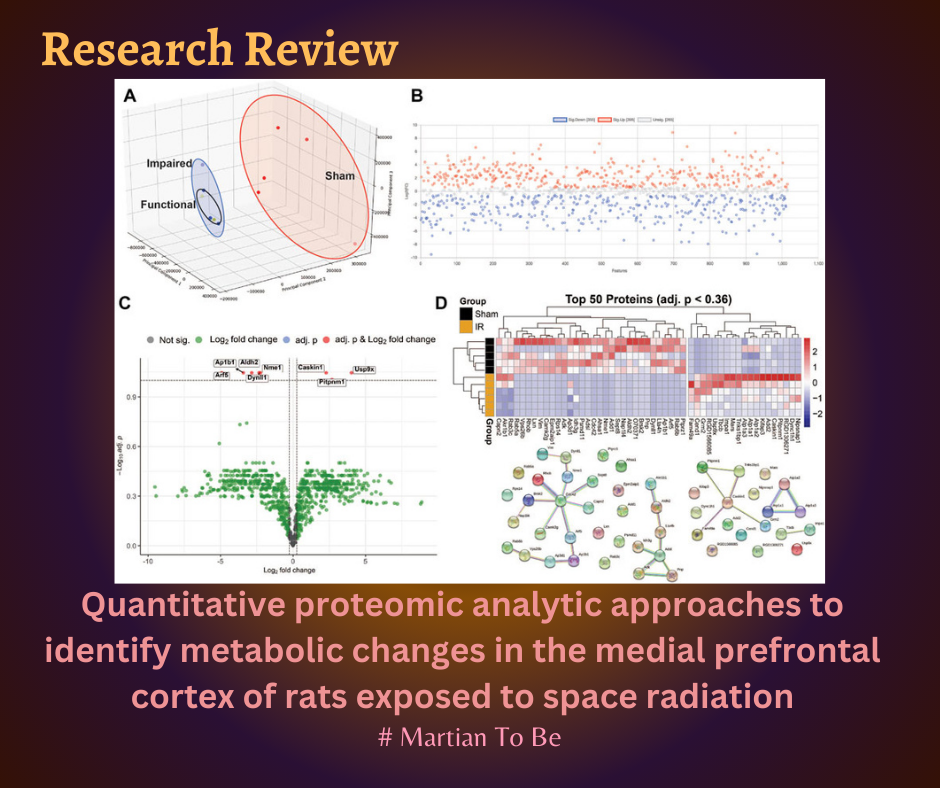
The paper aims to identify metabolic changes in the medial prefrontal cortex (mPFC) of rats exposed to space radiation (SR) and outlines strategies for analyzing sub-optimal data sets and identifying new information.
The study conducted proteomic analysis on rats exposed to SR and found decreased mitochondrial function and alterations in pathways related to cognitive performance. Contribution of this paper
 The paper contributes to the understanding of how space radiation (SR) exposure impacts neurophysiology, specifically in the medial prefrontal cortex (mPFC) of rats. It identifies several pathways and proteins that are altered as a result of SR exposure, including decreased mitochondrial function and proteomic changes associated with impaired cognitive performance.The study also outlines strategies for analyzing sub-optimal data sets and identifying new information, providing a framework for future research in this area.Additionally, the paper highlights the inter-individual variation in the incidence and severity of cognitive impairment caused by SR exposure, offering insights into the adaptive responses that prevent the emergence of cognitive impairment in some individuals.The findings of this study have important implications for risk assessments related to space travel and contribute to our understanding of the impact of SR on neurophysiology and cognitive function.
 The practical implications of this paper are:
 The practical implications of this paper include providing insights into the metabolic changes in the medial prefrontal cortex (mPFC) of rats exposed to space radiation (SR), which can help in understanding the potential impact of SR on cognitive function in astronauts during long-duration space missions.The identification of pathways and proteins that are altered by SR exposure, such as decreased mitochondrial function and proteomic changes related to cognitive performance, can inform the development of countermeasures to mitigate SR-induced cognitive impairment.The strategies outlined in the paper for analyzing sub-optimal data sets and identifying new information can be valuable for future research in this field, enabling researchers to make the most of limited or variable sample sizes.The findings also highlight the importance of considering inter-individual variation in the response to SR exposure, suggesting that adaptive responses can be invoked to prevent cognitive impairment in some individuals.Overall, this paper contributes to our understanding of the neurophysiological effects of SR exposure and provides a foundation for further research and the development of interventions to protect the cognitive health of astronauts during space missions.
 The methods used in this paper include:
 The methods used in this paper involved the analysis of proteomic data from the medial prefrontal cortex (mPFC) of rats exposed to space radiation (SR).The rats used in the study were a subset of male Wistar retired breeder rats that were irradiated with 15 cGy 600 MeVn 28 Si exposure at the NASA Space Radiation Laboratory (NSRL).The authors employed quantitative proteomic analytic approaches to identify metabolic changes in the mPFC. They used strategies such as pathway enrichment analysis, protein-protein interaction (PPI) analysis, and gene ontology analysis to gain insights into the impact of SR on neurophysiology and cognitive function.The data sets were analyzed using statistical methods, including permutation tests, to determine the significance of dysregulated gene sets.The results were presented using graphs, bar graphs, and network analysis to visualize the proteomic changes and protein-protein interactions in key pathways.Overall, the methods used in this paper aimed to identify and characterize the proteomic changes in the mPFC of rats exposed to SR, providing valuable insights into the neurophysiological effects of SR exposure and potential strategies for mitigating cognitive impairment.
 Data used in the studyThe data used in this paper includes proteomic data from the medial prefrontal cortex (mPFC) of rats exposed to space radiation (SR).The rats used in the study were a subset of male Wistar retired breeder rats that were irradiated with 15 cGy 600 MeVn 28 Si exposure at the NASA Space Radiation Laboratory (NSRL).The authors employed quantitative proteomic analytic approaches to analyze the proteomic changes in the mPFC. They used strategies such as pathway enrichment analysis, protein-protein interaction (PPI) analysis, and gene ontology analysis to identify metabolic changes and pathways affected by SR exposure.The proteomic data was analyzed using statistical methods, including permutation tests, to determine the significance of dysregulated gene sets.The results of the proteomic analysis were visualized using graphs, bar graphs, and network analysis to illustrate the proteomic changes and protein-protein interactions in key pathways.Overall, the data used in this paper consisted of proteomic data from the mPFC of rats exposed to SR, which was analyzed using various quantitative proteomic analytic approaches to identify metabolic changes and pathways affected by SR exposure.
 The results of this paper are:
 The paper aimed to identify metabolic changes in the medial prefrontal cortex (mPFC) of rats exposed to space radiation (SR) using quantitative proteomic analytic approaches.The authors analyzed proteomic data from the mPFC of rats exposed to SR and identified several pathways and proteins that were altered as a result of SR exposure, including decreased mitochondrial function.They also found that a subset of proteins differed in rats with high cognitive performance after SR exposure compared to those with low performance levels.The study provided insights into how SR impacts neurophysiology and adaptive responses to prevent SR-induced cognitive impairment.The authors outlined strategies for analyzing sub-optimal data sets and identifying new information.In terms of specific results, the authors identified proteins that were altered as a result of SR exposure and proteins whose expression was associated with the rats’ cognitive performance ability.They also found radiation-specific changes in the mPFC proteome and identified proteins that could explain the levels of cognitive performance in SR-exposed rats.Overall, the paper provided valuable information on the metabolic changes in the mPFC of rats exposed to SR and potential strategies for analyzing proteomic data and identifying key proteins associated with cognitive performance .
We value your ideas and feel free to comment below.
