
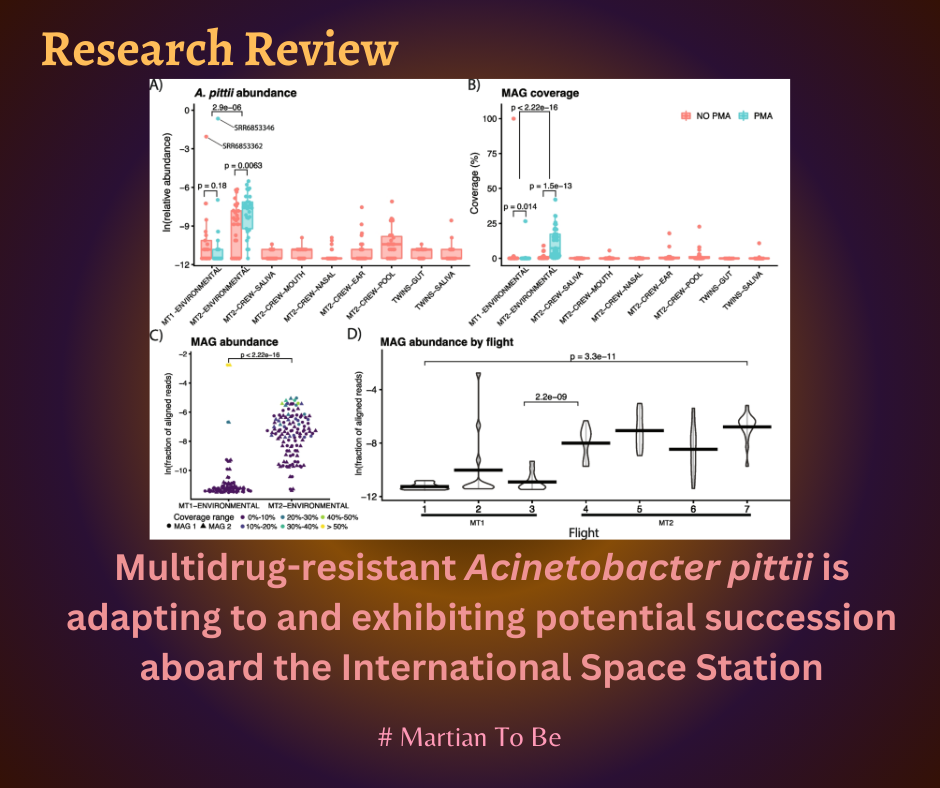
 Link to the paper: https://microbiomejournal.biomedcentral.com/…/s40168…
The paper discusses the adaptation of the opportunistic pathogen Acinetobacter pittii to the extreme environment of the International Space Station (ISS), including its acquisition of increased resistance to antibiotics and potential succession aboard the ISS. The study highlights the importance of monitoring microbial evolution and infection prevention in space environments. The contributions of this paper are:
 The paper highlights the adaptation of Acinetobacter pittii, an opportunistic pathogen, to the extreme environment of the International Space Station (ISS).The study reports that ISS-associated A. pittii has formed its own genetically and functionally discrete clade distinct from most Earth-bound isolates.The antimicrobial susceptibility testing of ISS strains and two related clinical isolates demonstrated that ISS strains acquired more resistance, specifically with regard to expanded-spectrum cephalosporins, despite no prediction of increased resistance based on genomic analysis of resistance genes.The study identified a high level of mutational burden in methionine sulfoxide reductase genes relative to the most closely related Earth strains.The paper highlights the importance of monitoring microbial evolution and infection prevention in space environments.
 The practical implications of this paper are:
 The study highlights the potential risk of microbial evolution and acquisition of antibiotic resistance in space environments, which could have implications for future space missions and the health of astronauts.The findings of this study could inform the development of infection prevention strategies for space environments, including the use of targeted antimicrobial therapies and the monitoring of microbial evolution and adaptation.The study also highlights the importance of continued monitoring and research on microbial evolution and adaptation in space environments to better understand the risks and potential impacts on human health.
 The methods used in this paper are:
 Broth microdilution with MicroScan Gram-negative NM56 trays was used for susceptibility testing using standard antibiotics.The taxonomy of each within-sample non-redundant bin was classified with GTDB-Tk in the same manner as for the isolate genomes.RGI (main) V5.2.1 running the default settings was used to identify antibiotic resistance genes and markers in the isolate genomes and metagenomic bins.A single-nucleotide polymorphism (SNP) and insertion/deletion (indel) genome-wide association study (GWAS) was computed using the strains most closely related to the ISS strains.The study also investigated 402 longitudinal environmental and host-associated ISS metagenomes to observe the relative abundance of viable A. pittii and its potential succession.The transcriptional regulator LexA was identified in ISS strains, which enables them to survive in harsh environments.The quality of A. pittii bins was evaluated and can be found in Supp Table 1.The minimum inhibitory concentrations (MICs) were interpreted according to the 2021 Clinical and Laboratory Standards Institute (CLSI) guidelines for Acinetobacter species.Pseudomonas aeruginosa and Escherichia coli ATCC 25922 were used as control strains as recommended in CLSI methods.
The data used in this paper includes publicly available environmental metagenomic datasets from the MT1 and MT2 missions, genomes of 402 A. pittii isolates of human clinical samples, and microbial sequencing associated with astronaut samples of MT-2 study and NASA Twins study (which cannot be shared publicly due to Institutional Review Board (IRB) but are available upon request in NASA Life Sciences Data Archive (LSDA)).
The results of the paper indicate that ISS-associated A. pittii has formed its own genetically and functionally discrete clade distinct from most Earth-bound isolates. The ISS strains acquired more resistance, specifically with regard to expanded-spectrum cephalosporins, despite no prediction of increased resistance based on genomic analysis of resistance genes. The viable A. pittii is increasing in relative abundance and therefore potentially exhibiting succession, being identified in >2X more metagenomic samples in back-to-back missions.
ISS strains additionally contain functions that enable them to survive in harsh environments, including the transcriptional regulator LexA. Via a genome-wide association study, a high level of mutational burden in methionine sulfoxide reductase genes relative to the most closely related Earth strains was identified. Overall, these results indicate a step forward in understanding how microorganisms might evolve and alter their antibiotic resistance phenotype in extreme, resource-limited, human-built environments.
We value your ideas and feel free to comment below.
