

 Link to the paper: https://www.nature.com/articles/s41526-023-00247-6
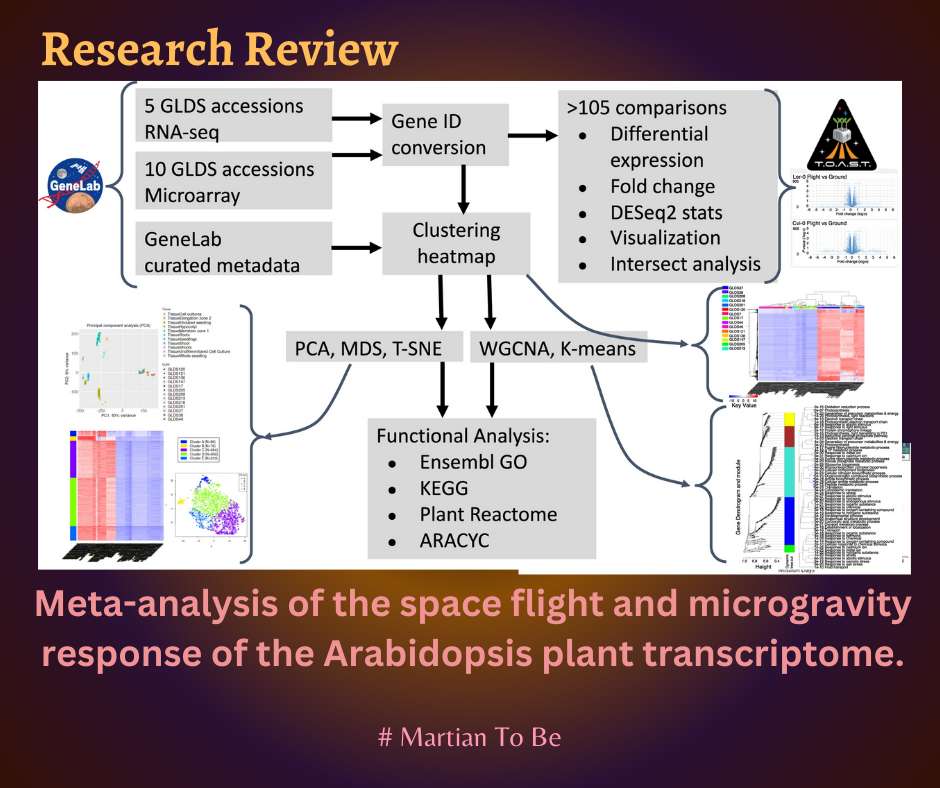
The paper is about analyzing the transcriptome of Arabidopsis plants in response to the complex environment of spaceflight. The study compares transcriptomic analysis of 15 Arabidopsis thaliana spaceflight experiments deposited in the National Aeronautics and Space Administration’s GeneLab data repository.
The contribution of this paper is the development of a standardized approach to analyzing transcriptomic data from Arabidopsis plants in response to the complex environment of spaceflight. The paper also provides a curated matrix of metadata associated with these experiments, which allows researchers to explore the wealth of plant biology transcriptomic data generated during spaceflight-related studies and provides an approach to better understand underlying factors impacting the robustness of comparisons made between the different datasets.
 The practical implications of this paper are as follows:
 The standardized approach to analyzing transcriptomic data from Arabidopsis plants in response to the complex environment of spaceflight can be used by researchers to better understand the plant response to spaceflight-related stressors and factors.
The curated matrix of metadata associated with these experiments can be used to select studies with high similarity scores, which share multiple elements of experimental design, such as plant age or flight hardware. Comparisons between these studies can help reduce the complexity in drawing conclusions arising from comparisons made between experiments with very different designs.
The findings of this study can be used to inform future spaceflight-related studies involving Arabidopsis plants and other plant species, and to develop strategies to mitigate the effects of spaceflight-related stressors and factors on plant growth and development.
The study highlights the importance of standardizing analysis across all datasets to reduce the potential for generating artifacts that are caused by making comparisons between datasets that have been the subject of different initial data analysis methodologies.
 The methods used in this paper are:
 The paper analyzed transcriptomic data from 15 Arabidopsis thaliana spaceflight experiments deposited in the National Aeronautics and Space Administration’s GeneLab data repository.
The studies were performed on missions run by NASA, the European Space Agency, and the Chinese Space Agency.
The primary data was reanalyzed through common computational approaches developed by GeneLab and implemented in the Galaxy computing environment.
The microarray analysis pipeline used the R/ Bioconductor software package limma to perform differential gene expression analysis.
The RNA-seq analysis pipeline used the universal RNA-seq aligner STAR v2.7.1a and the RNA-Seq by Expectation Maximization approach (RSEM v1.3.1) along with the TAIR10 genome assembly accessed through Ensembl Plants.
The paper used a standardized approach to analysis to increase the robustness of comparisons made between datasets.
The paper coupled the analysis with extensive cross-referencing to a curated matrix of metadata associated with these experiments to reduce the complexity in drawing conclusions arising from comparisons made between experiments with very different designs.
 The results of the paper are:
The paper revealed that factors such as analysis type (i.e., microarray versus RNA-seq) or environmental and hardware conditions have important confounding effects on comparisons seeking to define plant reactions to spaceflight.
The metadata matrix allows selection of studies with high similarity scores, i.e., that share multiple elements of experimental design, such as plant age or flight hardware.
Comparisons between these studies then helps reduce the complexity in drawing conclusions arising from comparisons made between experiments with very different designs.
The paper used a standardized approach to analysis to increase the robustness of comparisons made between datasets.
The paper coupled the analysis with extensive cross-referencing to a curated matrix of metadata associated with these experiments to reduce the complexity in drawing conclusions arising from comparisons made between experiments with very different designs.
We value your ideas and feel free to comment below.
