
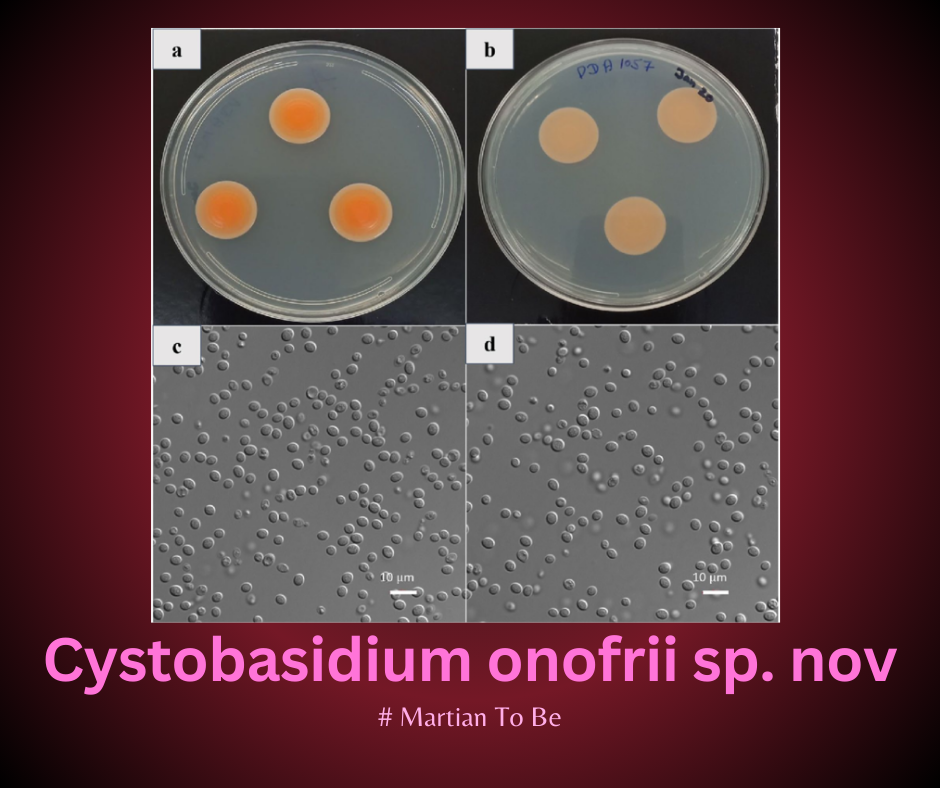
Cystobasidium onofrii sp. nov. is a novel species of fungus that was recently discovered in the Mars 2020 mission assembly facilities. It is a member of the Basidiomycota phylum, and it is most closely related to the fungus Cystobasidium albinellum. The species is named after Dr. Onofrii P. Stanchev, a leading expert on fungi.
Cystobasidium onofrii sp. nov. is a white, powdery fungus that grows on surfaces. It is radiation-tolerant, and it can survive doses of radiation that would kill other organisms. The fungus is also able to grow in extreme environments, such as those found on Mars.
The discovery of Cystobasidium onofrii sp. nov. is significant because it suggests that there may be other extremotolerant fungi living on Mars. These fungi could potentially be used to study the Martian environment, and they could also be used to develop new technologies for space exploration. Taxonomy
Kingdom: Fungi
Phylum: Basidiomycota
Class: Basidiomycetes
Order: Cystobasidiales
Family: Cystobasidiaceae
Genus: Cystobasidium
Species: Cystobasidium onofrii sp. Nov.
The species epithet “sp. nov.” stands for “species nova”, which means “new species” in Latin.
Here are some of the key features of Cystobasidium onofrii sp. nov. It is a white, powdery fungus.It grows on surfaces.It is radiation-tolerant.It can survive in extreme environments.It is most closely related to the fungus Cystobasidium albinellum.It was named after Dr. Onofrii P. Stanchev.
The discovery of this fungus is a reminder that there is still much that we don’t know about the universe. It is also a testament to the resilience of life, and it suggests that there may be other extremotolerant organisms living in other parts of the solar system.
Here are some additional details about Cystobasidium onofrii sp. nov.: It was isolated from the Mars 2020 mission assembly facilities at the Jet Propulsion Laboratory in California.The fungus is a yeast, and it has a single haploid nucleus.The cells are ovoid to ellipsoidal, with dimensions of 3-5 µm x 2-3 µm.The fungus is able to grow at temperatures ranging from 4 to 37 degrees Celsius.It is also able to grow in the presence of high levels of salt and radiation.
 Potential applications
 Studying the Martian environment: Cystobasidium onofrii sp. nov. could be used to study the effects of radiation and other environmental factors on microorganisms. This information could be used to help develop life support systems for future space missions.Developing new technologies: Cystobasidium onofrii sp. nov. could be used to develop new technologies for space exploration, such as food production and water purification systems.Reducing the risk of infection: Cystobasidium onofrii sp. nov. could be used to reduce the risk of infection on spacecraft by reducing the number of microorganisms present.
The discovery of Cystobasidium onofrii sp. nov. is a significant step forward in the development of technologies for space exploration. The fungus has the potential to be used in a variety of applications, and it could help to make space travel safer and more sustainable.
We value your ideas and feel free to comment below.
