
 Link to the paper: https://doi.org/10.1016/j.celrep.2022.111279
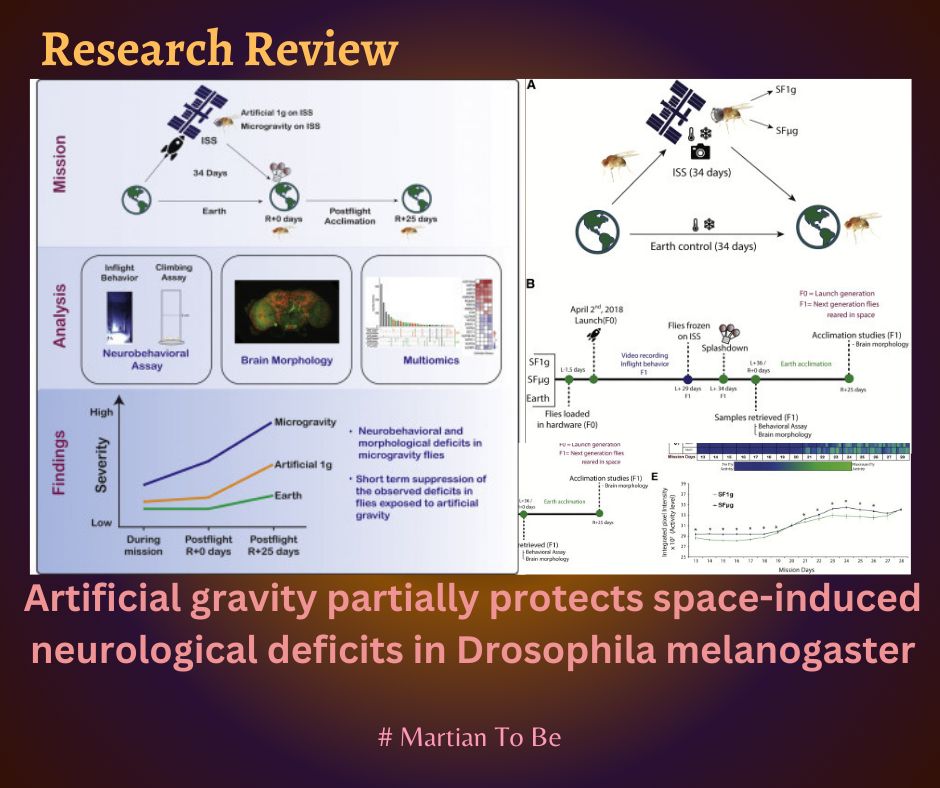
The paper investigates the effects of spaceflight on the fly nervous system and the value of artificial gravity (AG) as a countermeasure. The study found that artificial gravity partially protects the CNS from the adverse effects of spaceflight.
 The contributions of this paper are:
 Investigating the effects of spaceflight on the fly nervous system and the value of artificial gravity (AG) as a countermeasure.
Performing behavioral analyses, brain immunohistochemistry, proteomics, and transcriptomics on flies subjected to spaceflight microgravity (SFmg), inflight artificially simulated Earth gravity (SF1g), and environmentally matched ground control (Earth).
Showing inflight and postflight behavioral changes and morphological alterations in the brain immediately postflight in response to mg.
Revealing brain morphological changes in both SF1g and SFmg flies, with pronounced phenotypes in SFmg.
Providing comprehensive information on the effects of inflight AG exposure on CNS and postflight acclimation to Earth conditions.
The practical implications of this paper are:
The findings of this study can help in developing countermeasures to protect the nervous system of astronauts during long-duration space missions.
The study provides insights into the effects of spaceflight on the nervous system, which can be useful in understanding the mechanisms of neurodegenerative diseases on Earth.
The study highlights the importance of artificial gravity as a countermeasure to mitigate the adverse effects of spaceflight on the nervous system.
The study can also be useful in designing future spaceflight experiments and missions to ensure the safety and well-being of astronauts.
The methods used in this paper are:
The study used Drosophila melanogaster (fruit flies) as a model organism to investigate the effects of spaceflight on the nervous system.
The flies were subjected to spaceflight microgravity (SFmg), inflight artificially simulated Earth gravity (SF1g), and environmentally matched ground control (Earth).
Behavioral analyses, brain immunohistochemistry, proteomics, and transcriptomics were performed on the flies to assess the effects of spaceflight on the nervous system.
The study used a Multi-Generation Platform (MVP) hardware design that allowed for the passage of two generations of flies sequentially from adult fly chamber 2 to adult fly chamber 1.
The MVP hardware has video imaging capabilities, and 28-second video footage of the adult fly chambers was taken regularly throughout the 12-h light period.
The study also used temperature and humidity loggers to monitor the samples throughout the journey.
Dissections, fixation of brain tissue, and postflight behavioral analysis were performed within 24 h of arrival at NASA ARC (Return+0 days = R+0).
A small subset of flies separated by sex was placed in an incubator at 24 C for acclimation to earth condition for 25 days (Return+25 days = R+25), and the brains from these flies were processed for immunohistochemical analysis similar to R+0 flies.
During the mission, a small set consisting of only two MVP modules (synchronous control) was reared in a ground-based incubator with real-time changes in temperature, humidity, and CO2 matching the telemetry recorded on the ISS.
The Earth control flies were fixed in RNAlater and subjected to postflight analyses following the same timeline as the flies from ISS.
The data used in this paper are tandem mass spectra, charge states, and protein database entries from the Uniprot Drosophila proteome combined with common contaminant sequences from the Global Proteome Machine. The data were analyzed using Proteome Discoverer version 2.1 and SequestHT (Thermo Fisher Scientific, San Jose, CA, USA) software. The study also used behavioral analyses, brain immunohistochemistry, proteomics, and transcriptomics to assess the effects of spaceflight on the nervous system of Drosophila melanogaster.
The results of the paper show that spaceflight microgravity (SFmg) flies exhibit central nervous system (CNS) deficits and gene-expression changes. The study also found that cellular stress and metabolic reprogramming responses were observed in spaceflight flies. Acclimation of space flies to Earth showed brain deficits that were more severe in SFmg. However, the study found that artificial gravity partially protects the CNS from the adverse effects of spaceflight.
The study used Drosophila melanogaster as a model organism to investigate the effects of spaceflight on the nervous system. The data used in the study were tandem mass spectra, charge states, and protein database entries from the Uniprot Drosophila proteome combined with common contaminant sequences from the Global Proteome Machine. The data were analyzed using Proteome Discoverer version 2.1 and SequestHT software.
We value your ideas and feel free to comment below.
