
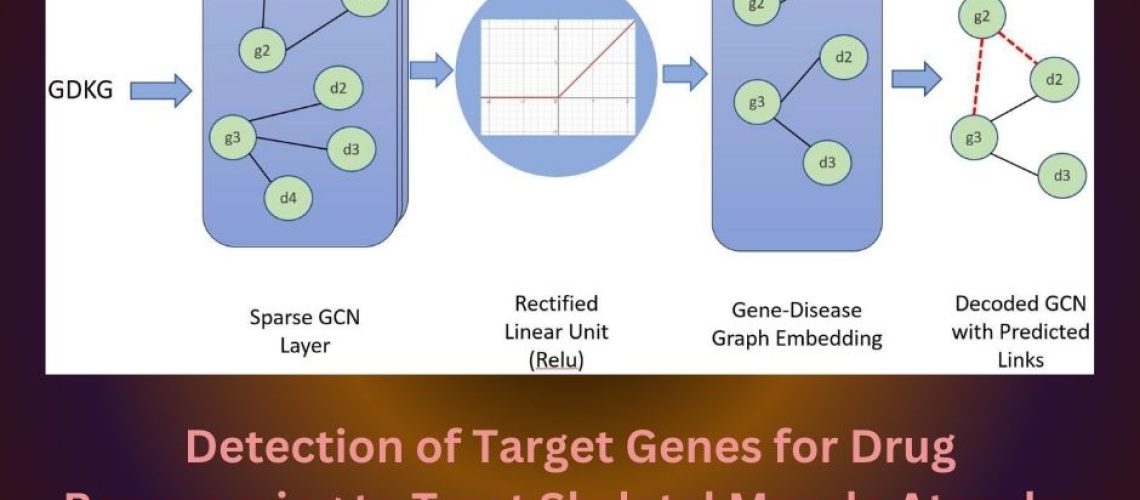
Link to the paper: https://www.mdpi.com/2073-4425/13/3/473
The paper investigates gene networks to repurpose drugs for treating skeletal muscle atrophy in conditions like aging, diabetes, and spaceflights.
It identifies key genes causing muscle atrophy and uses advanced algorithms like graph convolutional networks to predict gene-disease associations and select potential drugs for repurposing.
🟣Contributions of the paper
🔸The paper contributes by identifying key genes associated with skeletal muscle atrophy in various muscle tissues through advanced network analysis techniques.
🔸It utilizes link prediction algorithms to construct gene disease and disease drug networks, aiding in the selection of potential drugs for repurposing to treat muscle atrophy.
🔸The study employs methods like Pearson correlation, Bayesian Markov blanket, and graph convolutional networks to predict gene-disease associations and rank potential drugs for therapeutic interventions.
🔸By analyzing transcriptomic datasets from spaceflown mice and constructing gene disease knowledge graphs, the paper offers insights into the genetic basis of muscle atrophy and proposes drug candidates for repurposing.
🟤Practical implications of the paper
🔹The paper’s findings have practical implications for identifying potential drugs to treat skeletal muscle atrophy in conditions like aging, diabetes, and spaceflights.
🔹By utilizing advanced algorithms like graph convolutional networks and link prediction methods, the study offers a novel approach to repurpose existing drugs for muscle atrophy treatment.
🔹The identification of key genes associated with muscle atrophy and the construction of gene disease and disease drug networks provide a foundation for personalized medicine and targeted therapies.
🔹The research demonstrates the scalability of network analysis and machine learning methods in identifying repurposable drugs for medical conditions arising in long-duration spaceflights, potentially accelerating the drug discovery process.
🟣Methods used in the paper
🔸The paper utilized various methods for its analysis, including Random Forest (RF), Gradient Boost (GB), Graph Neural Network (GNN), and Graph Convolutional Networks (GCN) for link prediction and drug repurposing.
🔸Gene expression datasets were combined, and significantly regulated genes were extracted using Pearson correlation and Incremental Association Markov Blanket (IAMB) methods.
🔸Network analysis techniques, such as graph theoretic network analysis, were employed to detect key target genes associated with muscle atrophy in different muscle tissues.
🔸The study involved constructing gene disease knowledge graphs and disease drug knowledge graphs to predict gene-disease associations and identify potential drugs for treating skeletal muscle atrophy.
🟤Data Used in the Paper
🔹The research paper utilized transcriptomic datasets collected from mice flown in spaceflight, which were made available by GeneLab, to detect key target genes causing muscle atrophy in various muscle tissues.
🔹Seven gene expression datasets were combined, and significantly regulated genes were extracted using methods like Pearson correlation and Incremental Association Markov Blanket (IAMB) to identify 473 genes as important regulators of skeletal muscle atrophy in spaceflight.
🟣Results of the Paper
🔸Seven gene expression datasets were combined, and a total of 473 genes were identified as the most significantly regulated genes using methods like Pearson correlation and Incremental Association Markov Blanket (IAMB).
🔸The identified genes are considered important regulators of skeletal muscle atrophy in spaceflight, providing valuable insights into the molecular mechanisms underlying muscle wasting in conditions like aging, diabetes, and long-duration spaceflights.
🔸The study focused on detecting key target genes causing muscle atrophy in various muscle tissues, including the left and right extensor digitorum longus muscle tissue, gastrocnemius, quadriceps, and the left and right soleus muscles, using graph theoretic network analysis.
🔸The research also involved the construction of a gene disease knowledge graph and a disease drug knowledge graph to explore gene-disease associations and identify potential drugs for repurposing to treat skeletal muscle atrophy.
🔸Various machine learning algorithms, such as graph convolutional networks, graph neural networks, random forest, and gradient boosting methods, were trained using network features to predict links and rank top gene-disease associations for skeletal muscle atrophy, with the graph convolution network performing best in link prediction accuracy.
🟤Conclusions from the Paper
🔹The study successfully identified 473 genes as significant regulators of skeletal muscle atrophy in spaceflight, shedding light on the molecular mechanisms underlying muscle wasting in conditions like aging, diabetes, and long-duration spaceflights.
🔹Key target genes associated with muscle atrophy in various muscle tissues were detected using graph theoretic network analysis, providing insights into potential therapeutic targets for muscle atrophy.
🔹By constructing gene disease and disease drug knowledge graphs, the research facilitated the selection of drugs for repurposing to treat skeletal muscle atrophy, with nutrients, corticosteroids, anti-inflammatory medications, and insulin-related drugs being among the top candidates.
🔹Machine learning algorithms, including graph convolutional networks, graph neural networks, random forest, and gradient boosting methods, were leveraged to predict links and rank gene-disease associations, with the graph convolution network demonstrating superior performance in link prediction accuracy.
🔹Overall, the findings highlight the importance of understanding the genetic underpinnings of skeletal muscle atrophy and offer a promising approach for drug repurposing to combat this condition.
🟣Limitations of the Paper
🔸The study focused on gene expression datasets from mice flown in spaceflight, which may limit the generalizability of the findings to other conditions or species.
🔸The research primarily utilized computational methods and network analyses, which may not fully capture the complexity of skeletal muscle atrophy and its interactions in biological systems.
🔸The selection of drugs for repurposing was based on computational predictions and network analyses, which may require further validation through experimental studies to confirm their efficacy in treating skeletal muscle atrophy.
🔸The study did not explore the potential side effects or interactions of the repurposed drugs identified for treating muscle atrophy, which are crucial considerations in drug development.
🔸While machine learning algorithms were employed for predicting gene-disease associations, the accuracy and reliability of these predictions may be influenced by the quality and completeness of the input data and network features.
🟤Future Works Suggested in the Paper
🔹Explore the potential of integrating experimental validation studies to confirm the efficacy of the identified drugs for repurposing in treating skeletal muscle atrophy, enhancing the translational relevance of the findings.
🔹Investigate the broader applicability of the identified gene regulators and drug candidates across different conditions associated with muscle wasting, such as aging, diabetes, and other neurodegenerative diseases.
🔹Further refine the machine learning algorithms and network analysis methods to improve the accuracy and robustness of predicting gene-disease associations and drug repurposing candidates for skeletal muscle atrophy.
🔹Conduct comparative studies to evaluate the performance of different computational approaches in predicting links and ranking gene-disease associations, potentially exploring new algorithms or techniques for enhanced prediction capabilities.
🔹Consider expanding the research to include additional omics data, such as proteomic or metabolomic profiles, to gain a more comprehensive understanding of the molecular mechanisms underlying skeletal muscle atrophy and potential drug targets.
We value your ideas and feel free to comment below.
Martian To Be follow us 🤩
#mars #genes #drugrepurposing #skeleton #muscleatrophy
