
Link to the paper: https://pubmed.ncbi.nlm.nih.gov/35470505/
Ionizing radiation, a known health risk, was studied for its impact on DNA methylation-based markers of biological age in human bronchial epithelial cells.
High-LET 56Fe ions were significantly associated with accelerated epigenetic clock epiTOC2, indicating potential utility of epigenetic clocks in monitoring the health effects of galactic cosmic radiation.
The research paper focuses on exploring the impact of galactic cosmic radiation on epigenetic clocks in human bronchial epithelial cells.
Radiation, including galactic cosmic radiation, is known to contribute to cancer development through DNA damage and epigenetic modifications.
Previous studies have shown associations between radiation exposure and epigenetic clocks, which are linked to biological aging and cancer risk.
The research aims to investigate the relationships between different types of radiation exposure and epigenetic clocks in human bronchial epithelial cells.
Understanding these relationships can provide insights into radiation toxicity, cancer risk, and potential biomarkers for public health benefits.
🔵Contributions of the Paper
🔸Studied the relationships between galactic cosmic radiation (GCR) and epigenetic clocks in human bronchial epithelial cells.
🔸Identified a significant association between high-LET 56Fe ions and accelerated epigenetic clock epiTOC2, suggesting potential utility of epigenetic clocks in monitoring the health impacts of GCR.
🔸Demonstrated sensitivities of specific epigenetic clock measures to certain forms of GCR, providing insights into the effects of radiation on biological age markers.
🔸Highlighted the importance of understanding the impact of ionizing radiation on DNA methylation variability and biological age markers for assessing health risks associated with radiation exposure.
🟢Practical Implications of the Paper
🔹Epigenetic clocks, such as epiTOC2, could serve as useful tools for monitoring the health impacts of galactic cosmic radiation (GCR) exposure.
🔹Understanding the sensitivities of specific epigenetic clock measures to different forms of GCR can aid in assessing the biological effects of radiation exposure on human bronchial epithelial cells.
🔹The significant association between high-LET 56Fe ions and accelerated epiTOC2 highlights the potential for using epigenetic clocks to better comprehend the health risks associated with GCR.
🔹These findings suggest that epigenetic clocks may offer insights into the biological aging process influenced by radiation exposure, contributing to a better understanding of the health implications of GCR exposure.
⚫Study data and radiation exposure
🔹The study utilized a human bronchial epithelial cell dataset exposed to different doses of high-LET 56Fe, 28Si, and low-LET X-rays to analyze DNA methylation changes.
🔹Cells were irradiated and cultured for 3 months to observe radiation-induced methylation changes over time.
🔹The dataset included 102 samples and detailed information on cell handling, DNA extraction, and methylation processing.
Calculation of epigenetic clocks
Three cancer-relevant epigenetic clocks, DNAmAge, EpiTOC2, and MiAge, were applied to the bronchial epithelial cell line to estimate biological aging and cancer risk.
The epigenetic clocks were calculated using methylation Beta values and publicly available online calculators and R code.
These clocks provide valuable insights into the cumulative number of stem cell divisions and total cell divisions in tissues, aiding in cancer risk assessment.
Statistical analysis
Linear models were used to analyze the relationships between radiation exposures and epigenetic clocks, adjusting for time-in-culture.
Interaction terms between radiation dose and time-in-culture were examined to understand their combined effects on the epigenetic clocks.
Statistical significance was determined using R software, and adjustments were made for multiple testing to control the family-wise error rate.
Radiation dose and time-in-culture interactions
Significant interactions were observed between high-LET 56Fe radiation and time-in-culture with epiTOC2, indicating potential effects on cancer risk.
However, these associations were not statistically significant after adjusting for multiple hypothesis testing.
Time-in-culture showed strong relationships with epiTOC2 and MiAge values in the absence of radiation exposure.
Overlapping CpG relationships
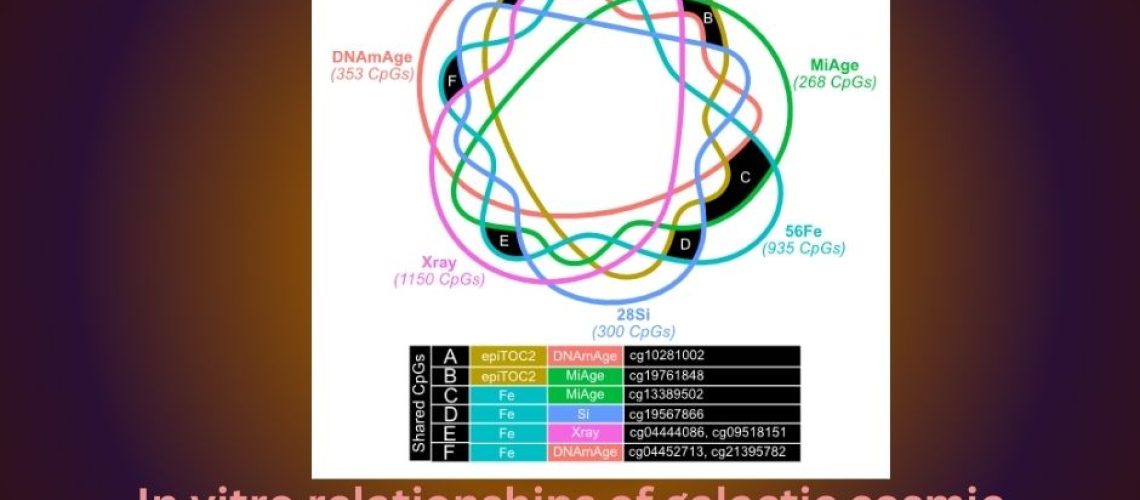
The study explored overlaps between CpGs associated with radiation exposure and those comprising the epigenetic clocks, revealing differential sensitivities to radiation types.
56Fe ions were notably associated with epiTOC2, suggesting increased cancer risk, while 28Si and X-rays showed no significant associations.
Limited overlap between radiation-associated CpGs and epigenetic clock component CpGs indicated unique DNA methylation changes induced by radiation exposure.
🔵Data Used in the Paper
🔸The study utilized a publicly available NCBI GEO Methylation450K BeadChip human bronchial epithelial cell dataset (Series GSE108187).
🔸The dataset consisted of 102 samples exposed to different doses of high-LET 56Fe, 28Si, and low-LET X-rays.
🔸Immortalized human bronchial epithelial cells (HBEC3-KT) were cultured for 3 months and samples were collected for DNA extraction and methylation analysis.
🔸Three biological replicate cultures were independently irradiated with specific doses of radiation, including 56Fe, 28Si, and X-rays.
🔸Detailed information on cell handling, DNA extraction, and methylation processing was included in the dataset for analysis.
🟢Results of the Study
🔹High-LET 56Fe radiation was significantly associated with accelerations in epiTOC2, a measure of biological age, in human bronchial epithelial cells.
🔹A positive interaction between 56Fe ions and time-in-culture was observed with epiTOC2, indicating a combined effect on biological aging.
🔹The direct association of 56Fe ions with epiTOC2 remained statistically significant even after adjusting for multiple hypothesis testing, highlighting the impact of this specific type of radiation on epigenetic clocks.
🔹Epigenetic clocks, including Horvath DNAmAge, MiAge, and epiTOC2, were not significantly associated with high-LET 28Si and low-LET X-rays, suggesting varying sensitivities to different forms of galactic cosmic radiation.
🔹The findings of the study indicate that specific epigenetic clock measures may serve as useful tools for monitoring and understanding the health effects of galactic cosmic radiation, particularly in the context of biological aging in human bronchial epithelial cells.
🟤Conclusions from the Research Paper
🔸Galactic cosmic radiation (GCR), specifically high-LET 56Fe radiation, was found to have a significant impact on accelerating biological aging in human bronchial epithelial cells.
🔸The study revealed a positive interaction between 56Fe ions and time-in-culture, indicating a combined effect on the epigenetic clock epiTOC2.
🔸While high-LET 56Fe radiation showed a strong association with epigenetic clocks, such as epiTOC2, Horvath DNAmAge, and MiAge, no significant associations were observed with high-LET 28Si and low-LET X-rays, suggesting varying sensitivities to different types of GCR.
🔸The results suggest that epigenetic clocks, particularly epiTOC2, may serve as valuable tools for monitoring and understanding the health impacts of GCR, providing insights into biological aging processes in human bronchial epithelial cells.
🔸Overall, the study highlights the importance of considering the specific forms of radiation exposure when assessing the effects on epigenetic clocks and biological age, emphasizing the potential utility of epigenetic clocks in studying the health implications of cosmic radiation exposure.
🟣Limitations of the Research Paper
🔹The study focused specifically on human bronchial epithelial cells, limiting the generalizability of the findings to other cell types or tissues.
🔹Due to the in vitro nature of the study, the direct translation of the results to in vivo settings or human populations may be challenging.
🔹The research primarily examined the effects of galactic cosmic radiation (GCR) on epigenetic clocks, potentially overlooking other factors that could influence DNA methylation and biological aging.
🔹The study did not explore the long-term effects of radiation exposure on epigenetic clocks or biological age, warranting further research to understand the sustained impact over time.
🔹While the study identified associations between high-LET 56Fe radiation and epigenetic clocks, the mechanisms underlying these relationships were not fully elucidated, leaving room for further investigation into the molecular pathways involved.
🔹The sample size and experimental conditions in the study may have influenced the results, highlighting the need for replication studies with larger sample sizes and diverse experimental settings to validate the findings.
🔵Future Works Suggested in the Paper
🔸Investigate the impact of galactic cosmic radiation (GCR) on epigenetic clocks in different cell types or tissues to enhance the generalizability of the findings.
🔸Conduct in vivo studies to validate the in vitro results and better understand the real-world implications of GCR exposure on biological aging.
🔸Explore the potential interactions between GCR exposure and other environmental factors or stressors that could influence DNA methylation patterns and biological age.
🔸Longitudinal studies are needed to assess the long-term effects of radiation exposure on epigenetic clocks and biological aging trajectories, providing insights into the sustained impact over time.
🔸Further research should focus on elucidating the underlying molecular mechanisms linking high-LET 56Fe radiation to changes in epigenetic clocks, shedding light on the biological pathways involved in radiation-induced aging processes.
🔸Replicate the study with larger sample sizes and diverse experimental conditions to validate the associations between high-LET radiation and epigenetic clocks, ensuring the robustness and reliability of the results.
