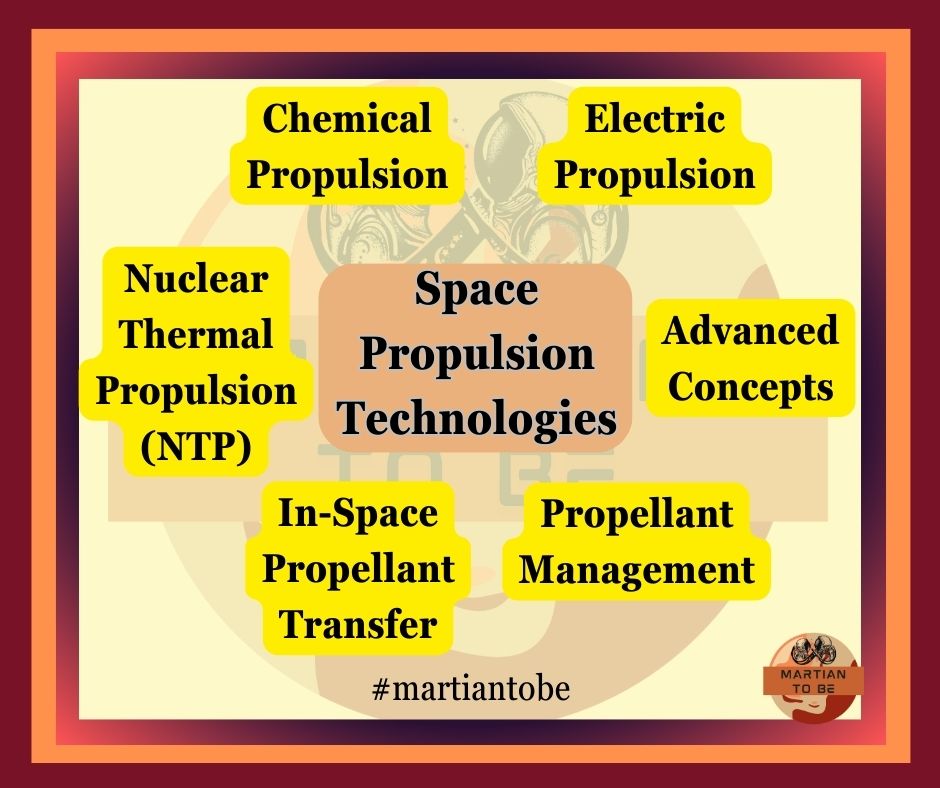
NASA has been actively involved in advancing space propulsion technologies to enable human exploration of deep-space destinations. The development of new propulsion systems is crucial for achieving the ambitious goals outlined in NASA’s Artemis program and other future deep-space missions. Here are some key areas of focus in space propulsion:
- Chemical Propulsion
- Traditional chemical propulsion systems, such as liquid and solid rocket engines, remain essential for launching spacecraft from Earth and conducting orbital maneuvers.
- Ongoing research aims to enhance the efficiency and performance of chemical propulsion systems to reduce travel times and increase payload capacities.
- Electric Propulsion
- Electric propulsion systems, including ion and Hall-effect thrusters, are gaining popularity for deep-space missions due to their higher efficiency and specific impulse compared to traditional chemical propulsion.
- NASA has been investing in the development and improvement of electric propulsion technologies to enable spacecraft to travel longer distances with less propellant.
- Nuclear Thermal Propulsion (NTP)
- Nuclear thermal propulsion involves using a nuclear reactor to heat a propellant, typically hydrogen, which is then expelled at high velocity to generate thrust.
- NASA is exploring nuclear thermal propulsion as a potential technology for crewed missions to Mars and other destinations. This technology could significantly reduce travel times compared to traditional chemical propulsion.
- In-Space Propellant Transfer
- Developing the capability to transfer propellant in space allows for more flexible mission architectures. This could involve refueling spacecraft in orbit or transferring propellant between spacecraft to extend mission durations.
- In-space propellant transfer is crucial for enabling long-duration missions to distant destinations.
- Propellant Management
- Efficient propellant management is critical for spacecraft with long mission durations. This includes systems for storing, transferring, and utilizing propellants effectively to maximize mission success.
- Advanced propellant management technologies help optimize spacecraft performance and resource utilization.
- Advanced Concepts
- Beyond the mentioned technologies, NASA continues to explore advanced propulsion concepts, such as solar sails, laser propulsion, and antimatter propulsion.
- These concepts aim to push the boundaries of space exploration by providing novel and potentially more efficient means of propulsion.
The development of these propulsion technologies aligns with NASA’s broader goals of sustainable and cost-effective space exploration. As technology advances, these innovations will play a crucial role in enabling crewed missions to the Moon, Mars, and other deep-space destinations. NASA collaborates with industry partners, research institutions, and international space agencies to accelerate the development and deployment of these propulsion systems.