
Link to the paper: https://iconsmat.com.au/wp-content/uploads/2020/03/v1.2.2.pdf
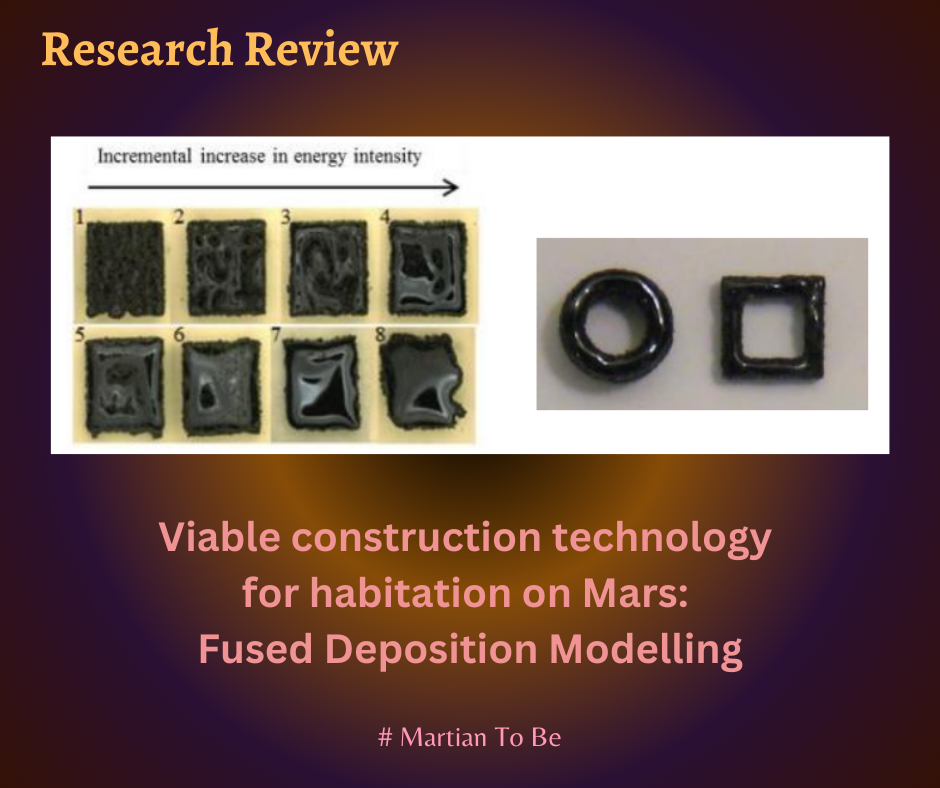
The paper investigates the properties of cementitious materials on Mars and proposes Fused Deposition Modelling as a viable construction technique for durable construction materials on Mars.
The study explores the use of automation and robotics in the construction industry, specifically for building habitats on Mars, and highlights the benefits of implementing such techniques.
Contributions of the paper
– The paper investigates the properties of cementitious materials on Mars based on data published by NASA and proposes Fused Deposition Modelling as a viable construction technique for durable construction materials on Mars.
– The study highlights the potential benefits of automation and robotics in the construction industry, specifically for building habitats on Mars. It suggests that automation can be easily applied to robots following a blueprint specific to Mars, allowing for the construction of multiple habitats with minimal human interference.
– The paper also mentions the contributions of the Australian Space Agency in improving construction and transportation methods to Mars, particularly in the areas of robotics, automation, and artificial intelligence.
Practical implications of the paper
– The paper suggests that Fused Deposition Modelling (FDM) can be a viable construction technique for producing durable construction materials on Mars, which has practical implications for future Mars colonization efforts.
– The study emphasizes the potential benefits of automation and robotics in the construction industry, specifically for building habitats on Mars. This has practical implications as it can streamline construction processes, reduce human interference, and increase productivity.
– The paper also highlights the importance of understanding the structural behavior of housing in extraterrestrial conditions by creating a livable environment on the Moon before embarking on the Martian mission. This approach can provide valuable insights and practical knowledge for constructing habitats on Mars.
– Additionally, the involvement of the Australian Space Agency in researching and developing technologies related to robotics, automation, and artificial intelligence for Mars habitation has practical implications for improving construction and transportation methods to Mars.
Overall, the practical implications of this paper include the potential use of FDM for construction on Mars, the benefits of automation and robotics in streamlining construction processes, the importance of understanding structural behavior in extraterrestrial conditions, and the contributions of the Australian Space Agency in advancing technologies for Mars habitation.
Methods used in this paper
– The paper utilizes data published by NASA and scientific principles to investigate the expected properties of cementitious materials on Mars.
– It proposes Fused Deposition Modelling (FDM) as a viable construction technique for producing durable construction materials on Mars.
– The study discusses the benefits of automation and robotics in the construction industry, specifically for building habitats on Mars. It emphasizes the potential for automation to streamline construction processes and minimize human interference.
– The paper also highlights the contributions of the Australian Space Agency in researching and developing technologies related to robotics, automation, and artificial intelligence for Mars habitation.
Note: The paper does not explicitly mention the specific methods used for data analysis or experimentation.
Data used in this paper
– The paper utilizes data published by NASA and scientific principles to investigate the expected properties of cementitious materials on Mars.
– The chemical composition of Martian soil was understood through remote telescopic observations and data obtained from the Viking Lander and Mars Pathfinder missions. These data revealed the presence of iron oxide, aluminosilicates, and other components in the soil.
– The paper references the utilization of basalt 3D printing approach and the mechanical properties of basalt, such as modulus of elasticity and tensile strength, as supporting evidence for its suitability as a construction material on Mars.
– The radiation resistance of basalt is also mentioned as a convincing property for its use in Martian shelters.
– The paper cites various research articles, including those on the utilization of in-situ resources and 3D printing structures for a manned Mars mission, the brittle strength of basaltic rock masses, and the development and testing of in-situ materials for human exploration of Mars.
– The paper does not explicitly mention the specific methods used for data analysis or experimentation.
Results of the paper
– The paper investigates the properties of cementitious materials on Mars based on data published by NASA and scientific principles. It proposes Fused Deposition Modelling (FDM) as a viable construction technique for producing durable construction materials on Mars .
– The cylindrical shape is identified as the most suitable architectural form for surface habitats on Mars, providing the greatest ratio of usable area to volume .
– The paper emphasizes the importance of automation and robotics in the construction industry, particularly for building habitats on Mars. It suggests that automation can enhance productivity, speed, and cost-effectiveness .
– The Australian Space Agency is mentioned as a potential contributor to research and technology related to Mars habitation, with a focus on robotics, automation, and artificial intelligence .
– The paper does not explicitly provide specific experimental results or findings.
